
Science & Technology
UN adopts first global artificial intelligence resolution


The United Nations General Assembly on Thursday unanimously adopted the first global resolution on artificial intelligence that encourages countries to safeguard human rights, protect personal data, and monitor AI for risks, Reuters reported.
The nonbinding resolution, proposed by the United States and co-sponsored by China and over 120 other nations, also advocates the strengthening of privacy policies.
“Today, all 193 members of the United Nations General Assembly have spoken in one voice, and together, chosen to govern artificial intelligence rather than let it govern us,” U.S. Ambassador to the United Nations Linda Thomas-Greenfield said.
The resolution is the latest in a series of initiatives – few of which carry teeth – by governments around the world to shape AI’s development, amid fears it could be used to disrupt democratic processes, turbocharge fraud or lead to dramatic job losses, among other harms.
“The improper or malicious design, development, deployment and use of artificial intelligence systems … pose risks that could … undercut the protection, promotion and enjoyment of human rights and fundamental freedoms,” the measure says. In November, the U.S., Britain and more than a dozen other countries unveiled the first detailed international agreement on how to keep artificial intelligence safe from rogue actors, pushing for companies to create AI systems that are “secure by design.”
Europe is ahead of the United States, with EU lawmakers adopting a provisional agreement this month to oversee the technology. The Biden administration has been pressing lawmakers for AI regulation, but a polarized U.S. Congress has made little headway, read the report.
In the meantime, the White House sought to reduce AI risks to consumers, workers, and minorities while bolstering national security with a new executive order in October.
U.S. National Security Advisor Jake Sullivan said it took nearly four months to negotiate the resolution, but that it gave the world “a baseline set of principles to guide next steps in AI’s development and use.”
Asked on Wednesday whether negotiators faced resistance from Russia or China, senior administration officials said there were “lots of heated conversations,” but the administration actively engaged with countries with which it has different views.
Like governments around the world, Chinese and Russian officials are eagerly exploring the use of AI tools for a variety of purposes. Last month, Microsoft said it had caught hackers from both countries using Microsoft-backed OpenAI software to hone their espionage skills.
In response to the Microsoft report, China has said it opposes what it called groundless accusations while Russia did not respond to a request for comment, Reuters reported.







Science & Technology
Australia social media ban set to take effect, sparking a global crackdown
For the social media businesses, the implementation marks a new era of structural stagnation as user numbers flatline and time spent on platforms shrinks, studies show.

Australia is set to become the first country to implement a minimum age for social media use on Wednesday, with platforms like Instagram, TikTok and YouTube forced to block more than a million accounts, marking the beginning of an expected global wave of regulation.
From midnight, 10 of the biggest platforms will be required to block Australians aged under 16 or be fined up to A$49.5 million ($33 million), Reuters reported.
The law received harsh criticism from major technology companies and free speech advocates, but was praised by parents and child advocates.
The rollout closes out a year of speculation about whether a country can block children from using technology that is built into modern life. And it begins a live experiment that will be studied globally by lawmakers who want to intervene directly because they are frustrated by what they say is a tech industry that has been too slow to implement effective harm-minimisation efforts.
Governments from Denmark to Malaysia – and even some states in the U.S., where platforms are rolling back trust and safety features – say they plan similar steps, four years after a leak of internal Meta (META.O) documents showed the company knew its products contributed to body image problems and suicidal thoughts among teenagers while publicly denying the link existed.
“While Australia is the first to adopt such restrictions, it is unlikely to be the last,” said Tama Leaver, a professor of internet studies at Curtin University.
“Governments around the world are watching how the power of Big Tech was successfully taken on. The social media ban in Australia … is very much the canary in the coal mine.”
A spokesperson for the British government, which in July began forcing websites hosting pornographic content to block under-18 users, said it was “closely monitoring Australia’s approach to age restrictions.”
“When it comes to children’s safety, nothing is off the table,” they added.
Few will scrutinise the impact as closely as the Australians. The eSafety Commissioner, an Australian regulator tasked with enforcing the ban, hired Stanford University and 11 academics to analyse data on thousands of young Australians covered by the ban for at least two years.
Though the ban covers 10 platforms initially, including Alphabet’s (GOOGL.O), YouTube, Meta’s Instagram and TikTok, the government has said the list will change as new products appear and young users switch to alternatives.
Of the initial 10, all but Elon Musk’s X have said they will comply using age inference – guessing a person’s age from their online activity – or age estimation, which is usually based on a selfie. They might also check with uploaded identification documents or linked bank account details.
Musk has said the ban “seems like a backdoor way to control access to the internet by all Australians” and most platforms have complained that it violates people’s right to free speech.
For the social media businesses, the implementation marks a new era of structural stagnation as user numbers flatline and time spent on platforms shrinks, studies show.
Platforms say they don’t make much money showing advertisements to under-16s, but they add that the ban interrupts a pipeline of future users. Just before the ban took effect, 86% of Australians aged 8 to 15 used social media, the government said.
“The days of social media being seen as a platform for unbridled self-expression, I think, are coming to an end,” said Terry Flew, the co-director of University of Sydney’s Centre for AI, Trust and Governance.
Platforms responded to negative headlines and regulatory threats with measures like a minimum age of 13 and extra privacy features for teenagers, but “if that had been the structure of social media in the boom period, I don’t think we’d be having this debate,” he added.
Science & Technology
Ethiopian volcano erupts for first time in nearly 12,000 years
Ash from the eruption drifted across the region, spreading over Yemen, Oman, India, and parts of Pakistan.
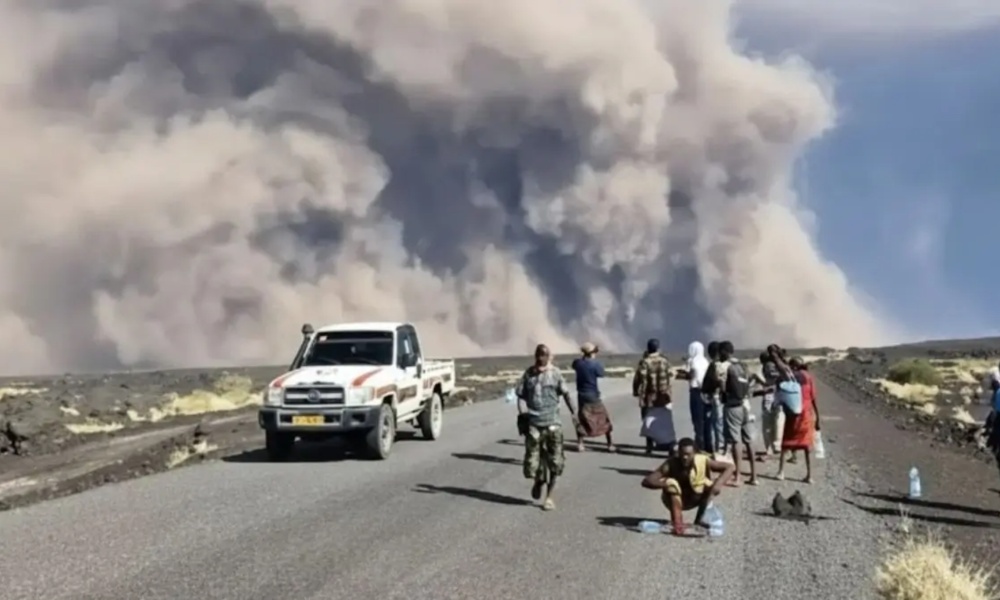
The Hayli Gubbi volcano in Ethiopia’s Afar region has erupted for the first time in almost 12,000 years, sending massive ash plumes soaring up to 14 kilometres into the atmosphere, according to the Toulouse Volcanic Ash Advisory Centre.
The eruption began on Sunday and lasted several hours. Hayli Gubbi, located around 800 kilometres northeast of Addis Ababa near the Eritrean border, sits within the geologically active Rift Valley, where two major tectonic plates meet. The volcano rises roughly 500 metres above the surrounding landscape.
Ash from the eruption drifted across the region, spreading over Yemen, Oman, India, and parts of Pakistan. Satellite imagery and social-media videos captured a towering column of white smoke billowing into the sky.
The Smithsonian Institution’s Global Volcanism Program notes that Hayli Gubbi has no recorded eruptions during the Holocene, the period dating back about 12,000 years to the end of the last Ice Age.
Volcanologist Simon Carn of Michigan Technological University also confirmed on Bluesky that the volcano had “no record of Holocene eruptions.”

A global outage at web-infrastructure firm Cloudflare began to ease on Tuesday afternoon after preventing people from accessing major internet platforms, including X and ChatGPT.
Cloudflare, whose network handles around a fifth of web traffic, said it started to investigate the internal service degradation around 6:40 a.m. ET. It has deployed a fix but some customers might still be impacted as it recovers service.
The incident marked the latest hit to major online services. An outage of Amazon’s cloud service last month caused global turmoil as thousands of popular websites and apps, including Snapchat, were inaccessible due to the disruption.
Cloudflare – whose shares were down about 5% in premarket trading – runs one of the world’s largest networks that helps websites and apps load faster and stay online by protecting them from traffic surges and cyberattacks.
The latest outage prevented users from accessing platforms such as Canva, X, and ChatGPT, prompting users to log outage reports with Downdetector.
Downdetector tracks outages by collating status reports from a number of sources. “We saw a spike in unusual traffic to one of Cloudflare’s services beginning at 11:20 UTC. That caused some traffic passing through Cloudflare’s network to experience errors,” the company said in an emailed statement.
“We are all hands on deck to make sure all traffic is served without errors.”
X and ChatGPT-creator OpenAI did not immediately respond to requests for comment. – REUTERS


Chairman of US House intel panel criticizes Afghan evacuation vetting process

EU leaders agree joint borrowing to fund Ukraine, setting aside plan to use Russian frozen assets

Tahawol: Global concerns over migration escalation discussed

Islamic Emirate’s army now self-sufficient, says chief of army staff

Afghan health minister attends second WHO summit in India

Afghanistan U19 cricket team defeats India A U19

Afghanistan economy under pressure as Pakistan shocks reshape trade flows

Gaza death toll tops 70,000, health ministry says

India set to establish pharmaceutical factories in Afghanistan: MoIC

Afghanistan offers tax breaks, free land to attract Indian investors
Tahawol: Global concerns over migration escalation discussed

Saar: Calls for Afghanistan’s balanced, economy-oriented foreign policy discussed

Tahawol: Discussion on regional countries’ meetings on Afghanistan

Saar: Regional efforts to address Afghanistan-Pakistan issues discussed

Tahawol: Officials say interactions must be based on realities
-

 Latest News4 days ago
Germany speeds up admission of Afghans from Pakistan
-

 Sport4 days ago
IPL 2026 Auction set for Abu Dhabi with $28.6 million purse at stake
-

 Business5 days ago
Afghan economy posts second year of growth despite deep structural challenges
-

 Latest News4 days ago
Afghanistan to establish independent oil and gas authority
-

 Sport5 days ago
ATN to broadcast ‘The Best FIFA Football Awards 2025’
-

 Latest News4 days ago
US intelligence chief warns of ‘direct threat’ from suspected terrorists inside the country
-

 International Sports5 days ago
ILT20: Jahangir powers Dubai Capitals to nine-run win over Abu Dhabi Knight Riders
-

 Latest News3 days ago
IEA supreme leader stresses enforcement of Sharia law and sincere public service