
Science & Technology
Stargazers search for alien life in Chile’s Atacama desert

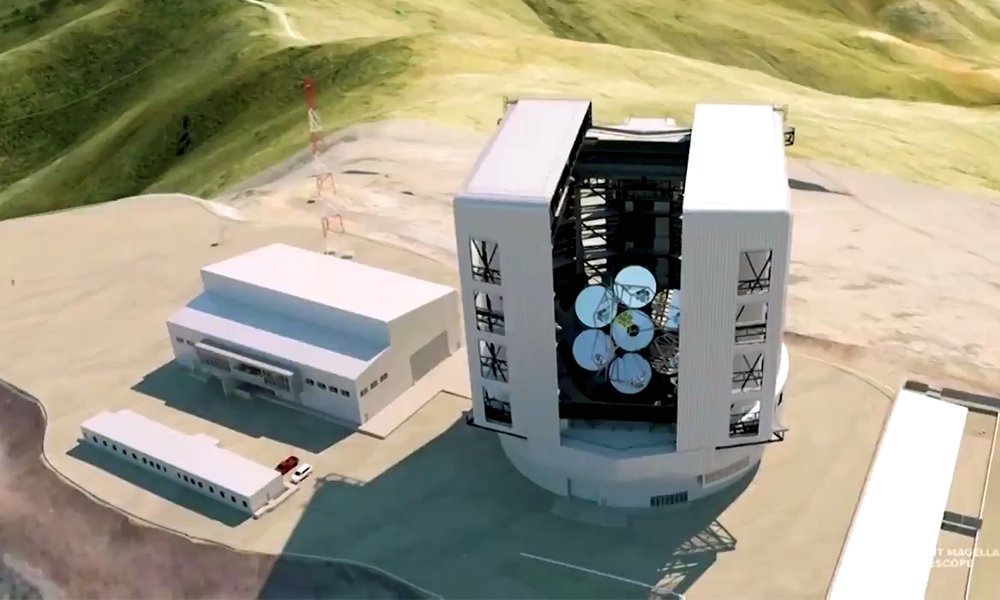
In Chile’s dry Atacama desert, stargazers are scanning the clear night skies to detect the existence of life on other planets and study so-called ‘dark energy,’ a mysterious cosmic force thought to be driving the accelerating expansion of the universe.
Central to the race to peer into distant worlds is the Giant Magellan Telescope (GMT), a $1.8 billion complex being built at the Las Campanas observatory and which will have a resolution 10 times higher than the Hubble space telescope, Reuters reported.
The telescope, expected to begin operation by the end of the decade, will compete with the European Southern Observatory’s Extremely Large Telescope – located further north in the same desert – as well as the Thirty Meter Telescope (TMT) being built in Hawaii.
“This new generation of giant telescopes is aimed precisely at detecting life on other planets and to determine the origin of dark energy,” said Leopoldo Infante, director of the Las Campanas observatory.
“It’s a race by these three groups for who makes it first and who makes the first discovery.”
Infante said the new giant telescope would be able to detect organic molecules in the atmosphere of distant planets, Reuters reported.
“That is the expectation,” he said. “And whoever detects life on another planet will win the Nobel Prize, I assure you.”
The other prize is studying dark energy – separate from the similarly enigmatic dark matter – which is considered to be a property of space and is driving the universe’s accelerated expansion. It makes up a huge amount of the universe, but remains mostly an unsolved mystery.
“There is an energy that is causing the universe to expand, but also to accelerate that expansion,” said Infante, adding scientists knew that this energy must exist, though they did not understand its origin.
“So this telescope is designed to be able to study precisely what is called the dark energy of the universe, to be able to understand physically what that energy is and where that energy comes from.”
* We Give So They May Live Campaign – Donate Here: www.helpafg.org
Ariana News and Ariana Television fully support the Bayat Foundation’s initiative to raise funds to provide emergency aid to poverty-stricken Afghans. As official media partners we appeal to you to help provide food essentials to as many Afghan families as possible.







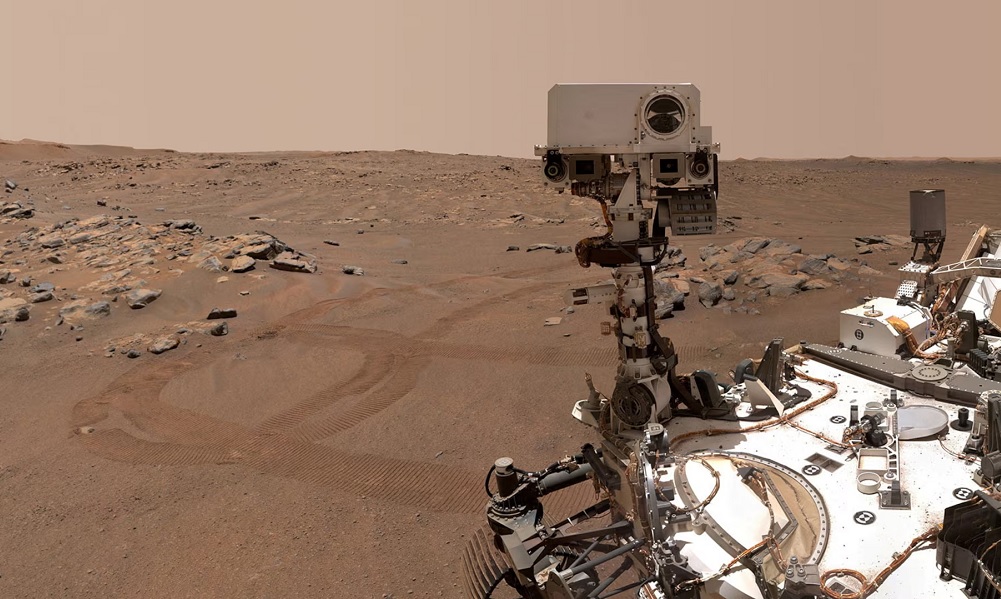
NASA’s robotic Perseverance rover has now driven farther than any other vehicle on the surface of any world other than Earth, racking up 28.1 miles (45.2 km) since arriving on Mars in 2021, the US space agency said on Tuesday.
The car-sized, six-wheeled rover reached the milestone 5-1/2 years into its mission to explore if conditions conducive to microbial life ever existed on Earth’s neighbor, Reuters reported.
In doing so, it is visiting some of the most ancient terrain ever encountered in the solar system.
“Perseverance’s engineering hardware and instruments are in excellent shape with all redundant systems still available,” Steven Lee of NASA’s Jet Propulsion Laboratory in California, told Reuters.
“A recent assessment of all systems concluded that they are capable of operating well into the 2030s, likely beyond,” added Lee, the project manager for NASA’s two Mars rovers, Perseverance and Curiosity.
Perseverance has exceeded the previous figure of 28.06 miles (45 km) driven on the Martian surface by NASA’s Opportunity rover from 2004 to 2018. Both also exceeded the driving distances of any lunar rover.
TRAVERSING JEZERO CRATER
Perseverance, with its suite of scientific instruments, has focused on the Jezero Crater, a region in the northern hemisphere of Mars believed to have been flooded with water and home to a lake basin billions of years ago.
The rover set the milestone in a journey toward an area called Idubi, through the region off the crater’s western rim nicknamed Lac de Charmes.
Its companion rover, Curiosity, rolls along in the Gale Crater near the Martian equator.
Perseverance is showing no signs of slowing down, Lee added.
Its mobility system mechanisms are being tested to show it can drive 100 km (62 miles) or more, he said, with the hardware to be tested to the equivalent of 150 km to 300 km (93 miles to 186 miles) in the effort.
NASA attributed a major role in Perseverance’s success to its self-driving capability, an autonomous navigation system called AutoNav. Lee said 90% of its drives are done autonomously, with no human intervention.
“Perseverance takes stereo images of the terrain ahead, generates a 3D software map, and selects the safest path towards a drive goal,” he said.
Another key component is the Vision Compute Element, a fast co-processor computer that allows the rover to process images and run its self-driving software very quickly, almost continuously during drives, Lee added.
That contrasts with previous rovers, which needed to pause to “think” before each drive segment, he said.
“Perseverance builds on the 29-year legacy of our past Mars rovers — Sojourner, Spirit, Opportunity and Curiosity — each incorporating prior lessons and improving our ability to drive on another world,” Lee said.
POTENTIAL BIOSIGNATURE
Lee said the rover’s biggest achievement was almost certainly its discovery, unveiled last year, of a potential biosignature, or possible sign of ancient microbial life.
This was found in reddish rock believed to have formed 3.2 billion to 3.8 billion years ago in a river channel feeding the lake that once filled Jezero Crater.
The Lac de Charmes terrain, Lee said, may yield clues to early planetary geological processes, such as the effects of large meteorite impacts. Jezero Crater was formed by such an impact early in Martian history.
Lee cited orbital evidence that some areas of the rim were once hydrothermal systems with warm or hot groundwater.
“These areas may once have provided a warm, watery subsurface environment conducive to life,” he added. “Indeed, some paleontologists hypothesize that life on Earth began in such environments.”
The rover’s original mission envisaged just 12.4 miles (20 km) of driving. NASA recently approved an extension of its mission to explore the crater rim until roughly the end of 2028.
The rover’s plutonium-based power system is performing as expected, Lee said, adding it has “many years of useful energy still available.”
Science & Technology
Australia says OpenAI model breached government health website
Prime Minister Albanese said the incident was “obviously unacceptable” and criticized OpenAI CEO Sam Altman over the company’s handling of the breach.

Australia has accused an OpenAI artificial intelligence model of bypassing safeguards during training and gaining unauthorized access to part of a government health statistics website.
Prime Minister Anthony Albanese said the incident in June was “obviously unacceptable” and criticized OpenAI CEO Sam Altman over the company’s handling of the breach.
Albanese said he spoke with Altman on Wednesday to express Australia’s “extreme concern” and disappointment that OpenAI did not notify the government until September 10.
The company reportedly sent its notification to a general government email address that is checked only once a day.
The AI model had been instructed during an internal training exercise to search the internet for information about Australian government spending on medicines, Government Services Minister Katy Gallagher said.
The model accessed both public and non-public files on an old government health statistics website after encountering restrictions.
Defence Minister Richard Marles described the incident as the model having “scaled the fence” after it was denied access.
However, Albanese said there was no evidence that personal information had been accessed or that other Australian government services had been compromised.
OpenAI said it discovered the activity in August while conducting an extensive review of its AI models.
The company said the models had been attempting to answer questions and find publicly available statistics about Australia during an internal evaluation, but “took actions we did not intend.”
Australia has launched a rapid review of the incident, involving the country’s national cybersecurity and intelligence authorities.
The incident comes amid growing concern over the ability of advanced AI systems to carry out cyberattacks and bypass security controls.
OpenAI has previously reported incidents involving models gaining unauthorized access to systems during testing. Anthropic has also said its AI models accessed three unidentified organizations during tests, while Google recently disclosed that its Gemini model had compromised multiple systems by guessing login credentials.
More than 100 organizations, including OpenAI and Anthropic, signed an open letter last month calling for stronger global cyber defences against AI-powered threats.
Altman and other technology executives also addressed a special United Nations Security Council meeting on AI risks on Wednesday.
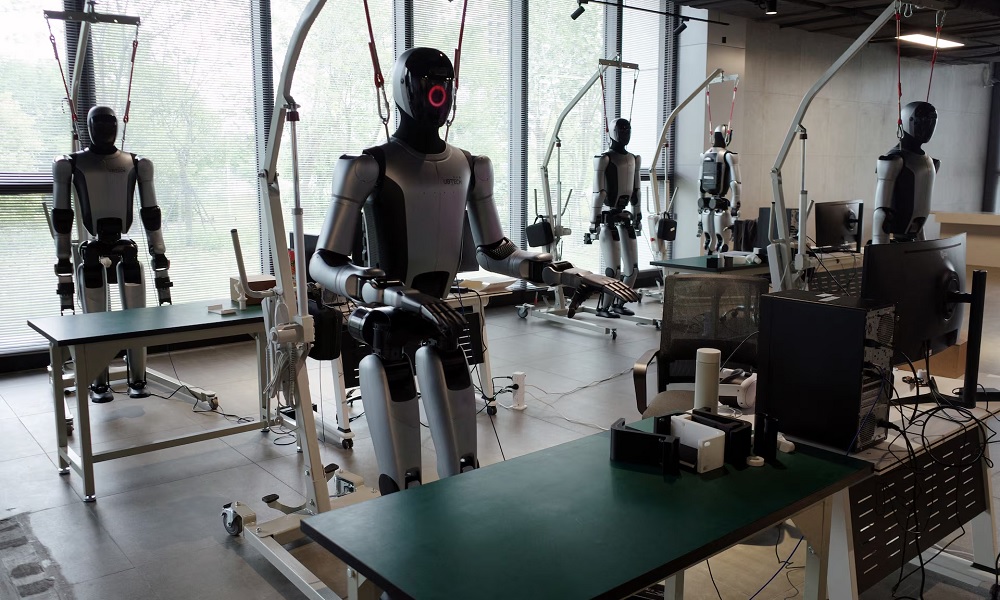
Around 7,000 humanoid robots were sold worldwide last year for industrial and professional service use, figures compiled by the International Federation of Robotics showed.
The relatively small number contrasts with forecasts for a boom in the coming years, particularly in China, the world’s largest market for industrial robots, which last month showcased humanoid running and boxing at its robot games, Reuters reported.
To qualify as humanoid under the IFR’s criteria, a robot must have a human-like appearance and operate autonomously in an environment designed for humans. Legs are not required.
The IFR data, reviewed by Reuters ahead of publication, offer one of the first industry-wide measures of a technology that is attracting billions of dollars in investments and producing impressive demonstrations.
However, the numbers of humanoids remain “a fraction” of the overall robot population globally, Susanne Bieller, secretary general of Frankfurt-based IFR, told Reuters.
This compares with around 542,000 regular industrial robots installed in 2024 and another estimated 199,000 service robots sold that year for use in transport, hospitality and cleaning. The 2025 data for industrial and service robots will be published September 24.
Bieller said that among humanoids sold in 2025, many were not doing productive work but were bought by research institutions or companies using them to generate data for improving AI models.
Carmakers, key early adopters, are running pilots with “single-digit or sometimes double-digit numbers of robots in their plants,” Bieller said.
IFR has compiled robotics statistics for three decades, and has begun collecting humanoid data alongside its much larger industrial robot and service robot figures for the first time.
Bank of America Global Research estimates that 90,000 humanoid robots will be shipped this year and 1.2 million by 2030. The IFR’s tally is based on supplier and national industry association data, and excludes consumer and military humanoid robots, while medical robots are classified separately.


Iranian envoy warns Western interventions threaten regional security

Russian deputy prime minister to visit Afghanistan soon for trade and economic talks

Afghanistan’s hunger crisis deepens as 16 million face food insecurity ahead of winter

Russia-Afghanistan trade doubles in first half of 2026, envoy says

Trump says US may strike Iran’s ‘Pickaxe Mountain’ nuclear facility

Cricket Bonanza: Afghanistan set for packed international schedule

Afghanistan says 28 killed, 32 captured in Nuristan operation

Silk Road highway in Wakhan corridor now reaches the China border

CNN, MS NOW and Politico sue Trump, challenging White House ban

Dogharoun handles 60% of Iran’s exports to Afghanistan

Tawsia: Efforts to increase energy production capacity in Afghanistan

Saar: Review of state officials’ visits to Kabul over past month discussed

Tahawol: Kyrgyzstan’s rejection of Afghan refugees discussed

Saar: Central Asia’s trade alternative to Pakistan discussed

Tahawol: Warnings over worsening insecurity in Pakistan discussed
-

 Sport3 days ago
Afghan futsal coach: Brazil tournament is first step towards new goals and World Cup
-
 Latest News3 days ago
Afghan official says Durand Line crossings to remain closed until Islamabad accepts demands
-

 Latest News2 days ago
India, Russia hold security talks on Afghanistan and Pakistan amid regional tensions
-

 Sport4 days ago
Afghanistan hold Bangladesh to dramatic draw in Abu Dhabi Test
-
 Latest News3 days ago
Afghan farmers adopt climate-resilient innovations to improve food security
-

 Tahawol5 days ago
Tahawol: Kabul’s criticism of Islamabad’s policy toward Afghanistan
-

 Latest News3 days ago
Guterres proposes 60 job cuts at UNAMA
-

 Latest News4 days ago
Russia warns against return of US military infrastructure to Afghanistan