
Latest News
Red Cross and Red Crescent reach 35-year milestone of serving communities in need

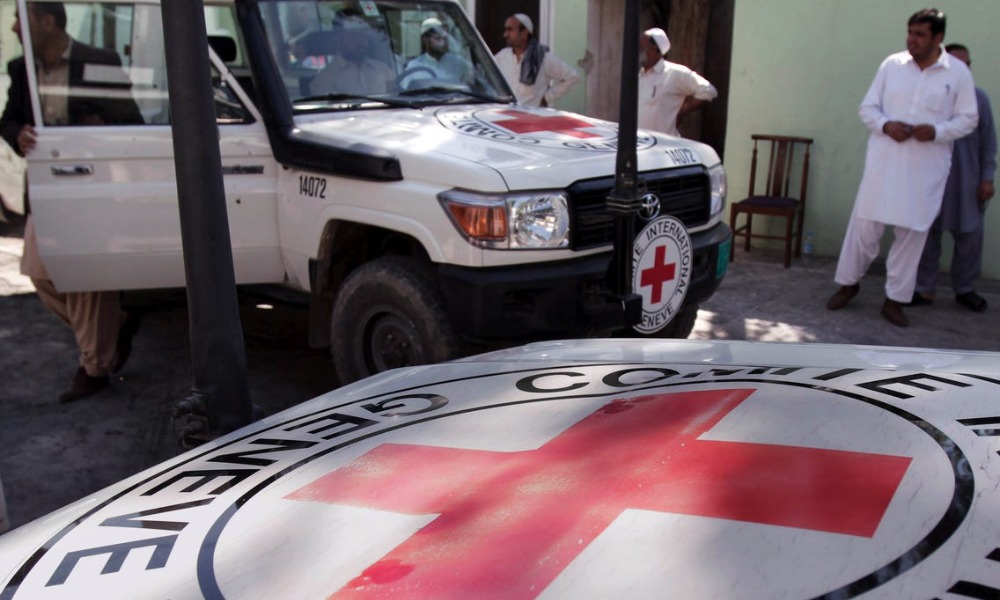
After 35 years of humanitarian assistance in Afghanistan, the Afghan Red Crescent Society (ARCS), the International Committee of the Red Cross (ICRC) and the International Federation of Red Cross and Red Crescent Societies (IFRC) on Tuesday reconfirmed their commitment to continue jointly providing lifesaving assistance to communities affected by war and violence.
In the 35 years of joint cooperation, the movement has reconnected thousands of families separated by disasters or violence; provided vital health care particularly for communities living in remote parts of the country; clarified the fate of the dead and worked to return the remains of the deceased to their families; and restored water and shelter among other vital humanitarian activities.
ARCS has also mobilized all teams and facilities in the COVID response effort over the past year and continues its engagement, including for the COVID vaccine rollout.
In a statement issued by the movement on Wednesday, they said that ARCS is present and active in all 34 provinces in Afghanistan through a wide network of local branches, volunteers and health facilities.
Every year, ARCS reaches more than 10 percent of the Afghan population through principled humanitarian action, the statement read.
“It has built trust and acceptance across the lines of conflict and with Afghan communities they belong to. ARCS has also the privilege to belong to the Red Cross and Crescent Movement which has been standing on its side always to support its development, meet the needs of people affected by disasters and crises and contribute to build more resilient Afghan communities,” said Nilab Mobarez, the Secretary General of Afghanistan Red Crescent Society, at a news conference.
“Although the shape of conflict and violence may have changed over the last decades, our commitment to protect civilians and promote respect for international humanitarian law has been constant. We’re proud of this and honoured to continue to work with the Red Cross and Red Crescent Movement to provide humanitarian assistance,” said Juan Pedro Head of Delegation for ICRC in Afghanistan.
“In the face of protracted vulnerabilities, including to climate change, the magnitude and intensity of the needs across the country call for enhanced cooperation of Red Cross Red Crescent partners to deepen our support to ARCS’ principled and nation-wide footprint, and to maximise our collective contribution and impact,” said Pierre Kremer, Head of Delegation for IFRC.
Against the backdrop of this milestone, the movement has signed an MoU and a Movement Coordination Agreement setting out their agreement to jointly deliver humanitarian assistance.
“This event aims to ensure a partnership of quality and mutual responsibility that seeks to achieve the highest humanitarian impact. The agreement sets a standard framework for administration, reporting and accountability, within which individual projects and initiatives can take place,” the statement read.
The ICRC and ARCS have worked in partnership since 1986 in addressing the conflict related needs of the Afghan population. The ICRC and ARCS’s commitment to neutral, independent, impartial humanitarian action (NIIHA), enable both partners to respond to emergencies and provide services where others cannot.
ARCS has worked to reduce suffering for people affected by disasters, conflict and violence since its creation in 1934.
The cooperation between ARCS and the ICRC stretches back further to the recognition of ARCS as a national society by movement in 1954 continuing to the present day with adaptations based on evolving humanitarian landscape, needs of the victims and other vulnerable persons as well as the institutional development of the ARCS and the operational ambitions of the ICRC in Afghanistan.
The Federation has had a constant presence in Afghanistan since 1990, to support ARCS and its humanitarian activities.






Chairman of U.S. House intelligence committee, Rick Crawford, has criticized the Biden administration’s handling of Afghan admissions to the United States following the 2021 withdrawal from Afghanistan.
In a statement, Crawford said that alongside large numbers of migrants entering through the U.S. southern border, approximately 190,000 Afghan nationals were granted entry under Operation Allies Welcome after the U.S. military withdrawal. He claimed that many of those admitted lacked proper documentation and, in some cases, were allowed into the country without comprehensive biometric data being collected.
Crawford said that the United States had a duty to protect Afghans who worked alongside U.S. forces and institutions during the two-decade conflict. However, he argued that the rapid and poorly coordinated nature of the withdrawal created conditions that overwhelmed existing screening and vetting systems.
“The rushed and poorly planned withdrawal created a perfect storm,” Crawford said, asserting that it compromised the government’s ability to fully assess who was being admitted into the country.
He said that there 18,000 known or suspected terrorists in the U.S.
“Today, I look forward to getting a better understanding of the domestic counterterrorism picture, and hearing how the interagency is working to find, monitor, prosecute, and deport known or suspected terrorists that never should have entered our country to begin with,” he said.
The Biden administration has previously defended Operation Allies Welcome, stating that multiple layers of security screening were conducted in coordination with U.S. intelligence, defense, and homeland security agencies. Nonetheless, the evacuation and resettlement of Afghan nationals remains a contentious political issue, particularly amid broader debates over immigration and border security.
U.S. President Donald Trump’s administration recently ordered its diplomats worldwide to stop processing visas for Afghan nationals, effectively suspending the special immigration program for Afghans who helped the United States during its 20-year-long occupation of their home country.
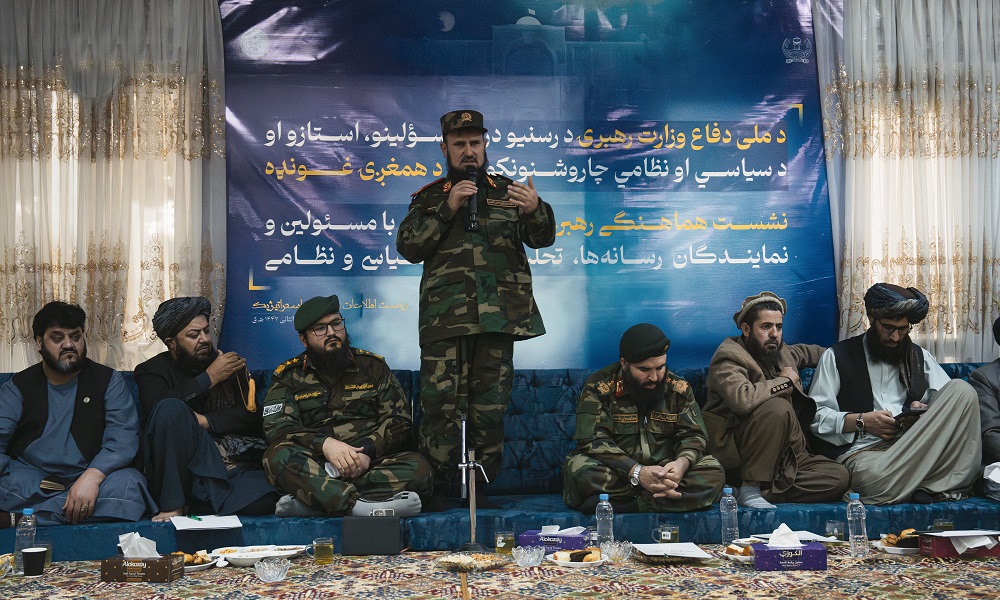
Mohammad Fasihuddin Fitrat, Chief of General Staff of the Armed Forces, says that over the past four years, the army forces of the Islamic Emirate have shown no hesitation in defending and protecting Afghanistan, and that today the country’s army is standing on its own feet.
According to a statement from the Ministry of Defense, Fitrat made these remarks at a meeting with media representatives, political analysts, and a number of government officials aimed at coordination and strengthening cooperation. He added: “Nations that cannot stand on their own feet and rely on others, even if they grow, will not be capable of achieving real progress.”
Fitrat also expressed appreciation for the role of the media in ensuring security and in supporting the country’s defense forces, stating: “We and you, as citizens of this land, must put our hands together and build the country together, take pride in our forces, and strive with all our strength for the country’s development. We have created an army that defends honor, territorial integrity, and the borders of the country, and serves as the guardian of our freedom.”
He emphasized that the Islamic Emirate is working to establish an army equipped with modern weapons so that it can defend the country’s territory under all circumstances.
He stated that the country’s army has proven to the people that anyone who looks at this land with ill intent will face a firm and courageous response, and that it has also been made clear to neighboring countries that any aggression against Afghanistan will be met with a response several times stronger.
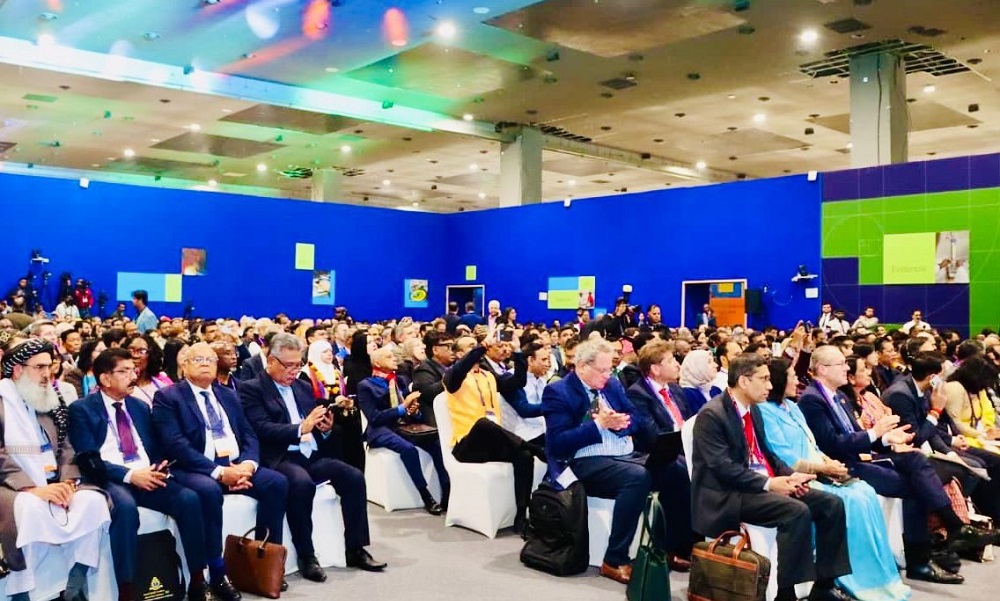
Noor Jalal Jalali, the Minister of Public Health of the Islamic Emirate, participated in the second World Health Organization meeting on traditional medicine during his official visit to India.
In a statement issued on Thursday, the Ministry of Public Health said that the meeting was held in India with the participation of representatives from around 100 countries, health ministers from 23 countries, professional experts from various nations, and officials from different departments of the World Health Organization.
During the meeting, discussions were held on the standardization of traditional medicine, training of individuals active in this field, recognition of traditional medicine as an established reality, and the sharing of countries’ experiences in this area.
The ministry stated that the purpose of participating in the conference was to standardize traditional medicine in Afghanistan, adding that for several decades this sector has been practiced in a non-standard manner and without a defined curriculum or clear principles.


Chairman of US House intel panel criticizes Afghan evacuation vetting process

EU leaders agree joint borrowing to fund Ukraine, setting aside plan to use Russian frozen assets

Tahawol: Global concerns over migration escalation discussed

Islamic Emirate’s army now self-sufficient, says chief of army staff

Afghan health minister attends second WHO summit in India

Afghanistan U19 cricket team defeats India A U19

Afghanistan economy under pressure as Pakistan shocks reshape trade flows

Gaza death toll tops 70,000, health ministry says

India set to establish pharmaceutical factories in Afghanistan: MoIC

Afghanistan offers tax breaks, free land to attract Indian investors
Tahawol: Global concerns over migration escalation discussed

Saar: Calls for Afghanistan’s balanced, economy-oriented foreign policy discussed

Tahawol: Discussion on regional countries’ meetings on Afghanistan

Saar: Regional efforts to address Afghanistan-Pakistan issues discussed

Tahawol: Officials say interactions must be based on realities
-

 Latest News4 days ago
Germany speeds up admission of Afghans from Pakistan
-

 Sport4 days ago
IPL 2026 Auction set for Abu Dhabi with $28.6 million purse at stake
-
 Business5 days ago
Afghan economy posts second year of growth despite deep structural challenges
-
 Latest News4 days ago
Afghanistan to establish independent oil and gas authority
-

 Sport5 days ago
ATN to broadcast ‘The Best FIFA Football Awards 2025’
-

 Latest News4 days ago
US intelligence chief warns of ‘direct threat’ from suspected terrorists inside the country
-

 International Sports5 days ago
ILT20: Jahangir powers Dubai Capitals to nine-run win over Abu Dhabi Knight Riders
-
 Latest News3 days ago
IEA supreme leader stresses enforcement of Sharia law and sincere public service