
Regional
Panic in Pakistan as India vows to cut off water supply over Kashmir
Islamabad has denied any role and said “any attempt to stop or divert the flow of water belonging to Pakistan … will be considered as an Act of War”.

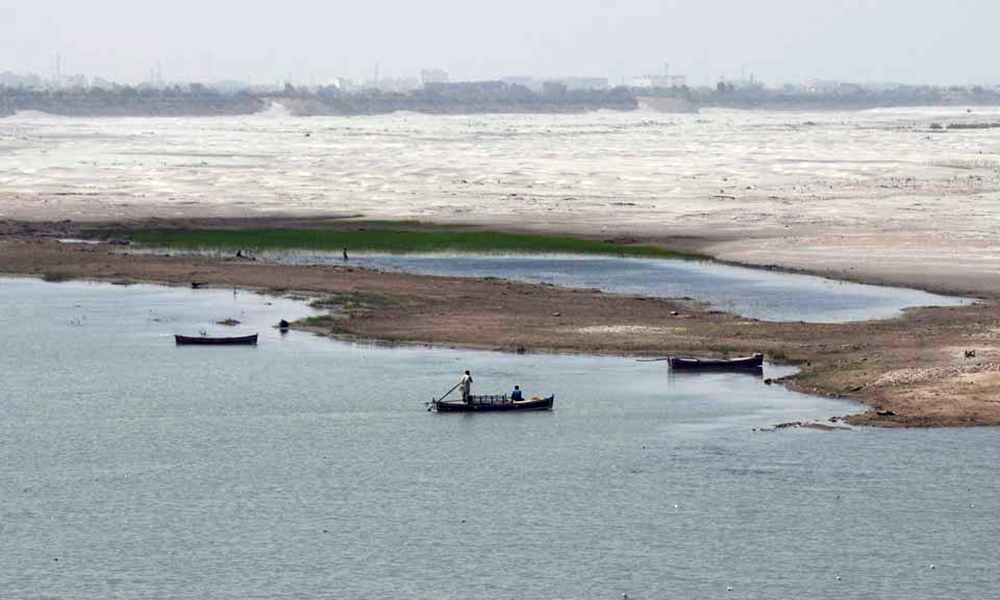
Pakistani farmers have voiced concern about future water supplies after India on Wednesday suspended the World Bank-mediated Indus Waters Tropy of 1960, which ensures water for 80% of Pakistan’s farms.
India said the suspension would last until “Pakistan credibly and irrevocably abjures its support for cross-border terrorism”.
This move comes after last week’s attack in Kashmir. India has accused Pakistan of having been involved, stating two of the three militants who attacked tourists and killed 26 men were from Pakistan.
Islamabad has denied any role and said “any attempt to stop or divert the flow of water belonging to Pakistan … will be considered as an Act of War”.
The treaty split the Indus and its tributaries between the nuclear-armed rivals.
Government officials and experts on both sides say India cannot stop water flows immediately, because the treaty has allowed it to only build hydropower plants without significant storage or dams on the three rivers allocated to Pakistan. But things could start changing in a few months, Reuters reported.
“We will ensure no drop of the Indus River’s water reaches Pakistan,” India’s water resources minister, Chandrakant Raghunath Paatil, said on X.
He did not respond to questions about the fears in Pakistan.
Two Indian government officials, who declined to be identified, said the country could within months start diverting the water for its own farms using canals while planning hydroelectric dams that could take four to seven years to finish.
Immediately, India will stop sharing data like hydrological flows at various sites of the rivers flowing through India, withhold flood warnings and skip annual meetings under the Permanent Indus Commission headed by one official each from the two countries, said Kushvinder Vohra, a recently retired head of India’s Central Water Commission.
“They will not have much information with them when the water is coming, how much is coming,” said Vohra, who was also India’s Indus Commissioner and now advises the government occasionally.
“Without the information, they cannot plan.”
And it is not just agriculture, a shortage of water will also hit electricity generation and potentially cripple the economy, economists say.
Vaqar Ahmed, economist and team lead with UK consulting firm Oxford Policy Management, said that Pakistan had underestimated the threat of India walking away from the treaty.
“India hasn’t got the kind of immediate infrastructure to halt the waterflows, especially during flood times, so this period creates a crucial window for Pakistan to address the inefficiencies in its water sector,” he said.
“There are a lot of inefficiencies, leakages.”
In recent years, Indian Prime Minister Narendra Modi’s government has been seeking to renegotiate the treaty and the two countries have been trying to settle some of their differences in the Permanent Court of Arbitration in the Hague over the size of the Kishenganga and Ratle hydroelectric plants’ water storage area, Reuters reported.
“We can now pursue our projects in free will,” said Vohra.
In a letter on Thursday, India told Pakistan that circumstances had changed since the treaty was signed, including population increases and the need for more cleaner energy sources, referring to hydropower.




Regional
Pakistan agrees to $4 billion arms deal with Libyan National Army
The package reportedly includes air, land and naval equipment and may involve the sale of JF-17 fighter jets and Super Mushak trainer aircraft to Libya.

Pakistan has reached a military equipment deal worth more than $4 billion with Libya’s eastern-based Libyan National Army (LNA), Pakistani officials said, despite a long-standing United Nations arms embargo on the country.
The agreement was finalised following a recent meeting in Benghazi between Pakistan’s Army Chief, Field Marshal Asim Munir, and Saddam Khalifa Haftar, the LNA’s deputy commander-in-chief. Officials said the deal will be implemented over about two and a half years, Reuters reported.
According to officials familiar with the agreement, the package includes air, land and naval equipment and may involve the sale of JF-17 fighter jets and Super Mushak trainer aircraft. Estimates of the deal’s value range between $4 billion and $4.6 billion, making it one of Pakistan’s largest-ever defence exports.
The LNA confirmed entering a defence cooperation pact with Pakistan, covering weapons sales, training and military manufacturing, though it did not provide details. Haftar described the agreement as the start of a “new phase of strategic military cooperation.”
Libya has been under a UN arms embargo since 2011, requiring international approval for weapons transfers. It remains unclear whether exemptions have been sought. Pakistani officials said the deal does not violate UN restrictions, noting that several countries continue to engage militarily with Libyan factions.
Pakistan has been actively expanding its defence exports, promoting its domestically produced and China co-developed JF-17 fighter as a lower-cost alternative to Western aircraft.
The Libya agreement would mark a significant expansion of Pakistan’s defence footprint in North Africa amid growing international competition for influence in the country.
Regional
Imran Khan calls for street movement, urges public to reclaim rights
Khan has appealed for collective action, saying the movement was necessary to restore the rule of law, ensure justice, and end what he described as politically motivated and pre-determined court decisions.
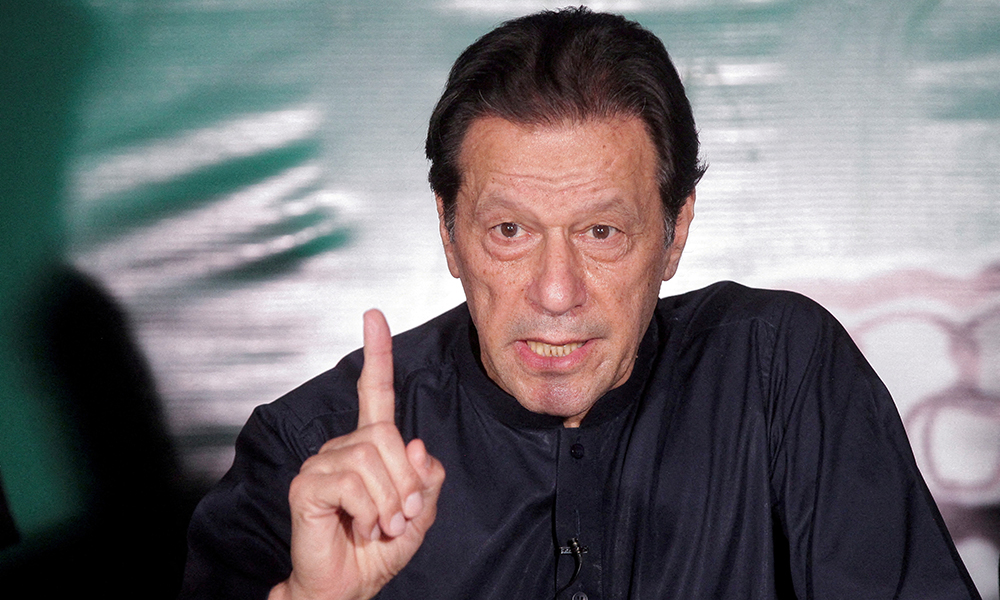
Former Pakistani Prime Minister Imran Khan has called on his supporters and the wider public to prepare for a nationwide street movement, urging citizens to rise in defense of their fundamental rights.
In a message issued from Adiala Jail, where he is currently detained, Khan appealed for collective action, saying the movement was necessary to restore the rule of law, ensure justice, and end what he described as politically motivated and pre-determined court decisions.
Khan said the recent verdict against him was part of sustained political pressure, alleging that the ruling was delivered without due legal process and without giving him a fair opportunity to present his defense. He warned that such practices have severely damaged the credibility of Pakistan’s judicial system.
The former prime minister also called on lawyers, constitutional experts, and members of the legal community to stand with the public and play an active role in safeguarding the Constitution and the rule of law. He said political stability and economic progress were impossible without an independent and impartial judiciary.
Addressing civil-military relations, Khan said his criticism was aimed at individuals rather than institutions. He described the military as belonging to the people of Pakistan, while alleging that actions taken against him in detention were carried out on the instructions of military authorities.
Khan drew comparisons with the 2007 political crisis, warning that continued erosion of the rule of law would have lasting consequences for the country. He praised judges who resist pressure as national heroes and criticized those who, he said, follow orders without question.
The statement comes amid heightened political and judicial tensions in Pakistan, with Khan’s trial and detention continuing to draw strong domestic and international attention.
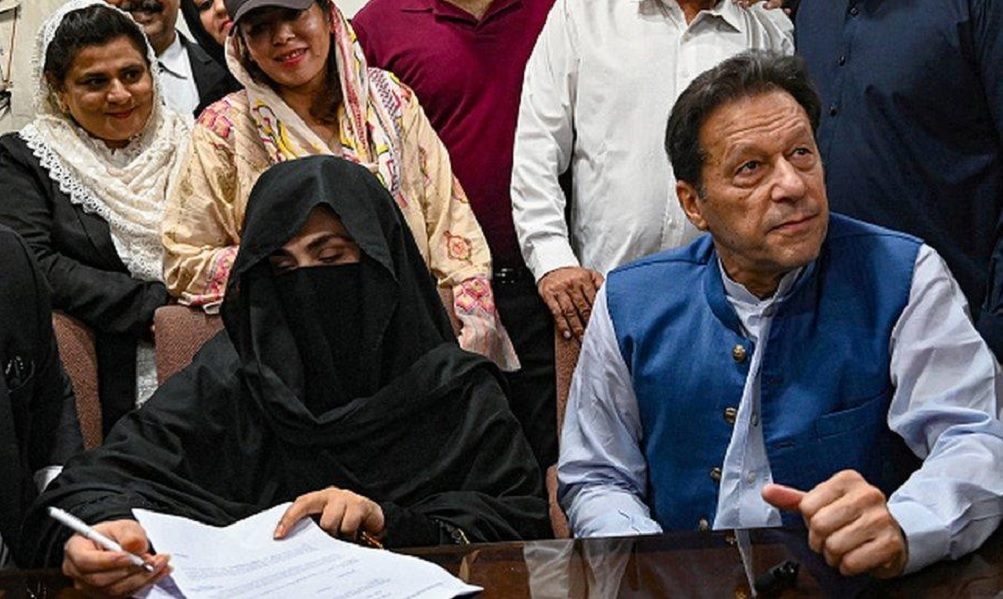
A Pakistani court on Saturday sentenced former Prime Minister Imran Khan and his wife Bushra Bibi to 17 years in prison each in a corruption case involving the under-priced purchase of luxury state gifts, the court and Khan’s lawyers said.
The latest conviction adds to a series of legal troubles for Khan, who has been behind bars since August 2023, and is currently serving a 14-year sentence in a separate land graft case, Reuters reported.
He faces dozens of cases filed since he was ousted from office in 2022, ranging from corruption to anti-terrorism and state secrets charges. Khan has denied wrongdoing in all the cases, which his party says are politically motivated.
“The court announced the sentence without hearing the defence and sentenced 17 years imprisonment to Imran Khan and Bushra Bibi with heavy fines,” Khan’s family lawyer Rana Mudassar Umer told Reuters.
They were handed 10 years’ rigorous imprisonment under Pakistan’s penal code for criminal breach of trust and a further seven years under anti-corruption laws, the special court of Pakistan’s Federal Investigation Agency said in its verdict.
He faces dozens of cases filed since he was ousted from office in 2022, ranging from corruption to anti-terrorism and state secrets charges. Khan has denied wrongdoing in all the cases, which his party says are politically motivated.
“The court announced the sentence without hearing the defence and sentenced 17 years imprisonment to Imran Khan and Bushra Bibi with heavy fines,” Khan’s family lawyer Rana Mudassar Umer told Reuters.
They were handed 10 years’ rigorous imprisonment under Pakistan’s penal code for criminal breach of trust and a further seven years under anti-corruption laws, the special court of Pakistan’s Federal Investigation Agency said in its verdict.
Khan’s jail term from Saturday’s ruling would begin after he has served the 14 years from the land graft case, Information Minister Attaullah Tarar said.
The case relates to luxury watches gifted to Khan by Saudi Arabia’s Crown Prince Mohammed bin Salman during official visits, which prosecutors said Khan and his wife then purchased from the state at a heavily discounted price in violation of Pakistan’s gift rules.
Tarrar said the purchase resulted in losses of several million rupees for the state.
Zulfi Bukhari, a spokesperson for Khan, said the verdict “ignores basic principles of justice” and turns the process into “a tool for selective prosecution.”
Khan has told his legal team to appeal the decision at the Islamabad High Court, Salman Safdar, another one of his lawyers, told reporters outside the jail where the trials were being held, Geo News reported.
ANOTHER STATE GIFTS CONVICTION
The case is separate from an earlier state gifts prosecution linked to Khan’s August 2023 arrest. Earlier sentences of 14 years for Khan and seven years for Bushra Bibi were later suspended on appeal. The couple denies wrongdoing.
The cases are commonly known in Pakistan as the Toshakhana cases, referring to the state repository where gifts received by public officials are deposited.
Following the verdict, Khan’s Pakistan Tehreek-e-Insaf (PTI) party announced plans for protests across Punjab on Sunday.
Khan’s party also says routine family and legal visits have been blocked in recent weeks despite court orders. Authorities deny any mistreatment and say he is receiving all facilities available to prisoners.
Khan, a former cricket star turned politician, remains one of Pakistan’s most polarising figures, with his legal battles unfolding as his Pakistan Tehreek-e-Insaf party remains sidelined from power.


Afghan Health Minister hails India visit as new chapter in bilateral ties

Power project signed to electrify 47,000 homes in Jawzjan

Ariana News to broadcast key AFC Champions League Two clash

Pakistani cleric condemns lifetime immunity for Army Chief as un-Islamic

Fazal Ur Rehman says Pakistan’s ‘attacks’ on Afghanistan are unjustifiable

Afghanistan economy under pressure as Pakistan shocks reshape trade flows

Gaza death toll tops 70,000, health ministry says

Iran rerouting more oil to China through Indonesia to dodge US sanctions

Islamic Emirate declines to attend Tehran meeting on Afghanistan

Cotton Industry in Crisis: Balkh farmers call for urgent action on exports

Tahawol: Return of 6.8 million Afghan refugees to IEA rule

Saar: Pakistan army chief’s allegations against Afghanistan

Tahawol: CSTO’s security concerns over Afghanistan

Saar: UNAMA’s activities in Afghanistan reviewed

Tahawol: Iran’s pledges to facilitate trade with Afghanistan discussed
-
 Latest News2 days ago
Afghanistan signs 30-year deal for marble mining in Daikundi
-

 Latest News4 days ago
Afghan border forces prevent illegal entry of hundreds into Iran
-
 Latest News3 days ago
Pakistan summons Afghan diplomat over deadly attack in North Waziristan
-
 Latest News3 days ago
Afghan health minister calls for medical cooperation between Kabul and New Delhi
-

 Latest News4 days ago
Japan allocates nearly $20 million in humanitarian aid for Afghanistan
-
 Latest News3 days ago
Karzai urges reopening of girls’ schools and universities for Afghanistan’s bright future
-
 Latest News2 days ago
Bush Institute criticizes Trump administration’s Afghan immigration freeze
-

 Health4 days ago
India issues over 200 medical visas to Afghans in last four months