
Regional
Israel, Hamas ceasefire accord followed by airstrikes on Gaza, residents say

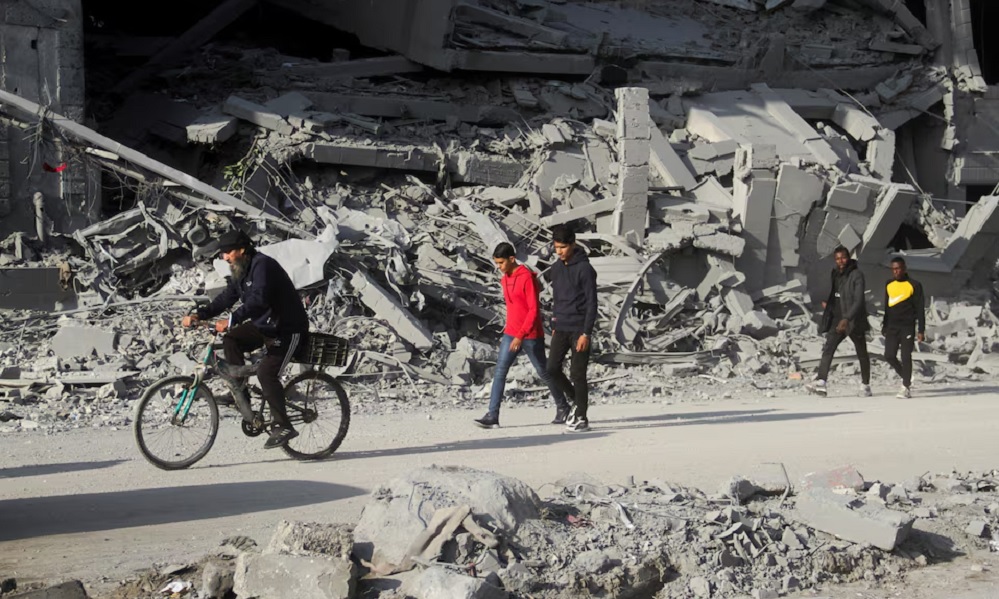
Israel intensified strikes on Gaza hours after a ceasefire and hostage release deal was announced, residents and authorities in the Palestinian enclave said, and mediators sought to quell fighting ahead of the truce’s start on Sunday.
The complex ceasefire accord between Israel and militant group Hamas, which controls Gaza, emerged on Wednesday after months of mediation by Qatar, Egypt and the U.S. and 15 months of bloodshed that devastated the coastal territory and inflamed the Middle East, Reuters reported.
The deal outlines a six-week initial ceasefire with the gradual withdrawal of Israeli forces from the Gaza Strip, where tens of thousands have been killed. Hostages taken by Hamas would be freed in exchange for Palestinian prisoners held by Israel.
At a news conference in Doha, Qatari Prime Minister Sheikh Mohammed bin Abdulrahman Al Thani said the ceasefire would take effect on Sunday. Negotiators are working with Israel and Hamas on steps to implement the agreement, he said.
“This deal will halt the fighting in Gaza, surge much-needed humanitarian assistance to Palestinian civilians, and reunite the hostages with their families after more than 15 months in captivity,” U.S. President Joe Biden said in Washington.
His successor, Donald Trump, takes office on Monday and claimed credit for the breakthrough in Gaza.
Israel’s acceptance of the deal will not be official until it is approved by the country’s security cabinet and government, with votes slated for Thursday, an Israeli official said.
The accord was expected to win approval despite opposition from some hardliners in Israeli Prime Minister Benjamin Netanyahu’s coalition government.
While people celebrated the pact in Gaza and Israel, Israel’s military escalated attacks after the announcement, the civil emergency service and residents said.
Heavy Israeli bombardment, especially in Gaza City, killed 32 people late on Wednesday, medics said. The strikes continued early on Thursday and destroyed houses in Rafah in southern Gaza, Nuseirat in central Gaza and in northern Gaza, residents said.
Israel’s military made no immediate comment and there were no reports of Hamas attacks on Israel after the ceasefire announcement.
A Palestinian official close to the ceasefire negotiations said mediators were seeking to persuade both sides to suspend hostilities ahead of the ceasefire going into effect.
JUBILATION IN GAZA
In social media posts, some Gaza residents urged Palestinians to exercise extra caution in the belief Israel could step up attacks in the next few days to maximize gains before the ceasefire starts.
Nevertheless, news of the ceasefire deal sparked jubilation in Gaza, where Palestinians have faced severe shortages of food, water, shelter and fuel. In Khan Younis, throngs clogged the streets amid the sounds of horns as they cheered, waved Palestinian flags and danced.
“I am happy. Yes, I am crying, but those are tears of joy,” said Ghada, a displaced mother of five.
In Tel Aviv, families of Israeli hostages and their friends likewise welcomed the news, saying in a statement they felt “overwhelming joy and relief (about) the agreement to bring our loved ones home.”
In a social media statement announcing the ceasefire, Hamas called the pact “an achievement for our people” and “a turning point.”
If successful, the ceasefire will halt fighting that has razed much of heavily urbanised Gaza, killed over 46,000 people and displaced most of the tiny enclave’s pre-war population of 2.3 million, according to Gaza authorities.
That in turn could defuse tensions across the wider Middle East, where the war has stoked conflict in the Israeli-occupied West Bank, Lebanon, Syria, Yemen and Iraq, and raised fears of all-out war between arch regional foes Israel and Iran.
With 98 Israeli hostages remaining in Gaza, phase one of the deal entails the release of 33 of them, including all women, children and men over 50. Two American hostages, Keith Siegel and Sagui Dekel-Chen, were among those to be released in the first phase, a source said.
FOOD LINED UP AT THE GAZA’S BORDERS
The agreement calls for a surge in humanitarian assistance to Gaza, and the U.N. and the International Committee of the Red Cross said they were preparing to scale up their aid operations.
“A ceasefire is the start – not the end. We have food lined up at the borders to Gaza – and need to be able to bring it in at scale,” said Cindy McCain, World Food Program executive director, on X.
Global reaction to the ceasefire was enthusiastic. Leaders and officials of Egypt, Turkey, Britain, the United Nations, the European Union, Jordan, Germany and the United Arab Emirates, among others, celebrated the news.
Biden and Trump both claimed credit for the deal that was months in the making but was helped across the line by a Trump emissary.
Trump’s Mideast envoy Steve Witkoff was in Qatar along with White House envoys for the talks, and a senior Biden administration official said Witkoff’s presence was critical to reaching a deal after 96 hours of intense negotiations.
Biden said that the two teams had “been speaking as one”.
Israeli hostage families expressed concern that the accord may not be fully implemented and some hostages may be left behind in Gaza.
Negotiations on implementing the second phase of the deal will begin by the 16th day of phase one, and this stage was expected to include the release of all remaining hostages, a permanent ceasefire and the complete withdrawal of Israeli forces from Gaza.
The third stage is to address the return of all remaining dead bodies and the start of Gaza’s reconstruction supervised by Egypt, Qatar and the United Nations.
If all goes smoothly, the Palestinians, Arab states and Israel must still agree on a vision for post-war Gaza, including the unanswered question of who will run Gaza after the war.
Israeli troops invaded Gaza after Hamas-led gunmen burst into Israeli border-area communities on Oct. 7, 2023, killing 1,200 soldiers and civilians and abducting over 250 hostages, according to Israeli tallies.






Regional
Pakistan agrees to $4 billion arms deal with Libyan National Army
The package reportedly includes air, land and naval equipment and may involve the sale of JF-17 fighter jets and Super Mushak trainer aircraft to Libya.

Pakistan has reached a military equipment deal worth more than $4 billion with Libya’s eastern-based Libyan National Army (LNA), Pakistani officials said, despite a long-standing United Nations arms embargo on the country.
The agreement was finalised following a recent meeting in Benghazi between Pakistan’s Army Chief, Field Marshal Asim Munir, and Saddam Khalifa Haftar, the LNA’s deputy commander-in-chief. Officials said the deal will be implemented over about two and a half years, Reuters reported.
According to officials familiar with the agreement, the package includes air, land and naval equipment and may involve the sale of JF-17 fighter jets and Super Mushak trainer aircraft. Estimates of the deal’s value range between $4 billion and $4.6 billion, making it one of Pakistan’s largest-ever defence exports.
The LNA confirmed entering a defence cooperation pact with Pakistan, covering weapons sales, training and military manufacturing, though it did not provide details. Haftar described the agreement as the start of a “new phase of strategic military cooperation.”
Libya has been under a UN arms embargo since 2011, requiring international approval for weapons transfers. It remains unclear whether exemptions have been sought. Pakistani officials said the deal does not violate UN restrictions, noting that several countries continue to engage militarily with Libyan factions.
Pakistan has been actively expanding its defence exports, promoting its domestically produced and China co-developed JF-17 fighter as a lower-cost alternative to Western aircraft.
The Libya agreement would mark a significant expansion of Pakistan’s defence footprint in North Africa amid growing international competition for influence in the country.
Regional
Imran Khan calls for street movement, urges public to reclaim rights
Khan has appealed for collective action, saying the movement was necessary to restore the rule of law, ensure justice, and end what he described as politically motivated and pre-determined court decisions.
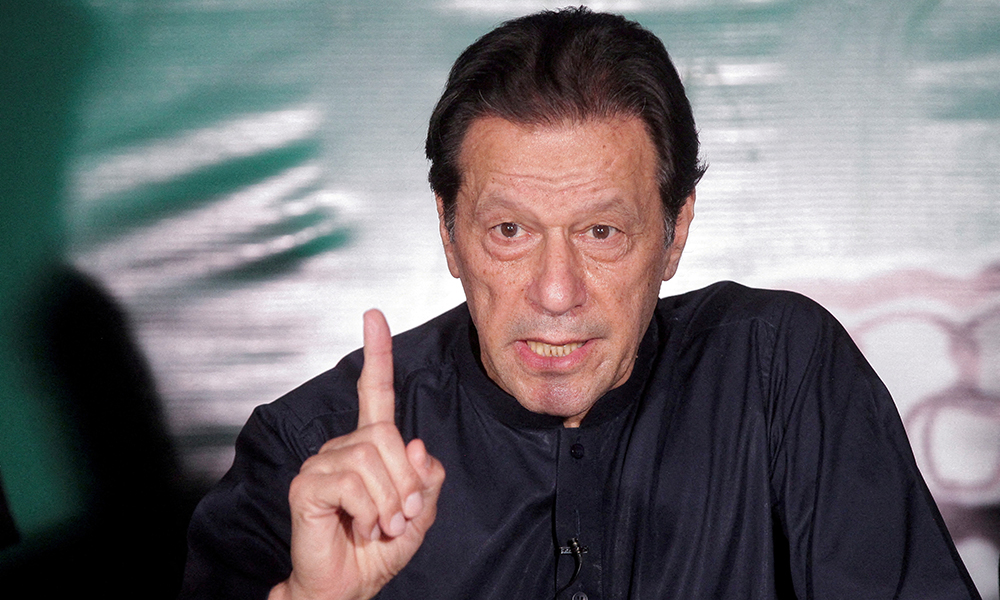
Former Pakistani Prime Minister Imran Khan has called on his supporters and the wider public to prepare for a nationwide street movement, urging citizens to rise in defense of their fundamental rights.
In a message issued from Adiala Jail, where he is currently detained, Khan appealed for collective action, saying the movement was necessary to restore the rule of law, ensure justice, and end what he described as politically motivated and pre-determined court decisions.
Khan said the recent verdict against him was part of sustained political pressure, alleging that the ruling was delivered without due legal process and without giving him a fair opportunity to present his defense. He warned that such practices have severely damaged the credibility of Pakistan’s judicial system.
The former prime minister also called on lawyers, constitutional experts, and members of the legal community to stand with the public and play an active role in safeguarding the Constitution and the rule of law. He said political stability and economic progress were impossible without an independent and impartial judiciary.
Addressing civil-military relations, Khan said his criticism was aimed at individuals rather than institutions. He described the military as belonging to the people of Pakistan, while alleging that actions taken against him in detention were carried out on the instructions of military authorities.
Khan drew comparisons with the 2007 political crisis, warning that continued erosion of the rule of law would have lasting consequences for the country. He praised judges who resist pressure as national heroes and criticized those who, he said, follow orders without question.
The statement comes amid heightened political and judicial tensions in Pakistan, with Khan’s trial and detention continuing to draw strong domestic and international attention.
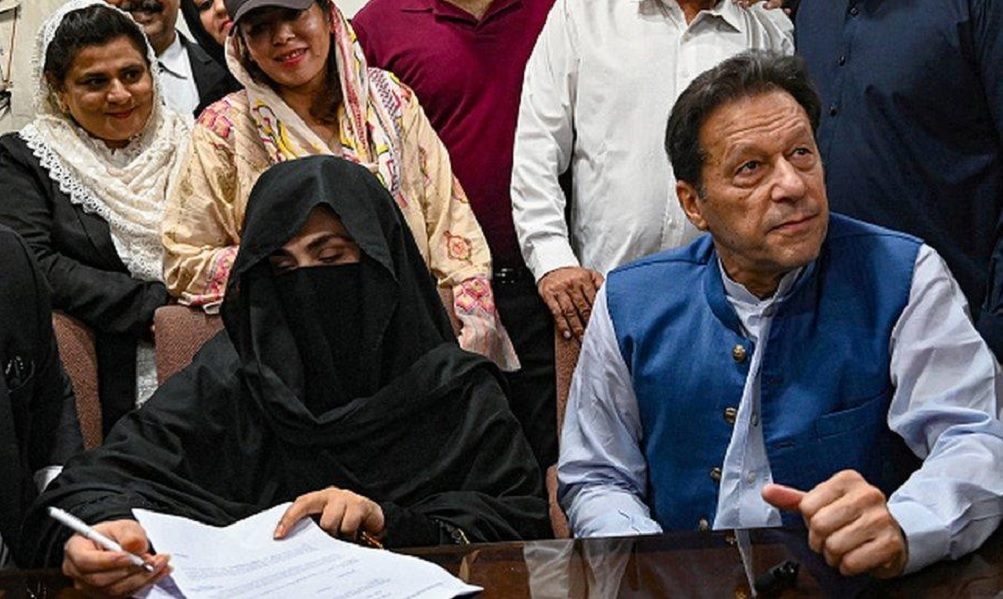
A Pakistani court on Saturday sentenced former Prime Minister Imran Khan and his wife Bushra Bibi to 17 years in prison each in a corruption case involving the under-priced purchase of luxury state gifts, the court and Khan’s lawyers said.
The latest conviction adds to a series of legal troubles for Khan, who has been behind bars since August 2023, and is currently serving a 14-year sentence in a separate land graft case, Reuters reported.
He faces dozens of cases filed since he was ousted from office in 2022, ranging from corruption to anti-terrorism and state secrets charges. Khan has denied wrongdoing in all the cases, which his party says are politically motivated.
“The court announced the sentence without hearing the defence and sentenced 17 years imprisonment to Imran Khan and Bushra Bibi with heavy fines,” Khan’s family lawyer Rana Mudassar Umer told Reuters.
They were handed 10 years’ rigorous imprisonment under Pakistan’s penal code for criminal breach of trust and a further seven years under anti-corruption laws, the special court of Pakistan’s Federal Investigation Agency said in its verdict.
He faces dozens of cases filed since he was ousted from office in 2022, ranging from corruption to anti-terrorism and state secrets charges. Khan has denied wrongdoing in all the cases, which his party says are politically motivated.
“The court announced the sentence without hearing the defence and sentenced 17 years imprisonment to Imran Khan and Bushra Bibi with heavy fines,” Khan’s family lawyer Rana Mudassar Umer told Reuters.
They were handed 10 years’ rigorous imprisonment under Pakistan’s penal code for criminal breach of trust and a further seven years under anti-corruption laws, the special court of Pakistan’s Federal Investigation Agency said in its verdict.
Khan’s jail term from Saturday’s ruling would begin after he has served the 14 years from the land graft case, Information Minister Attaullah Tarar said.
The case relates to luxury watches gifted to Khan by Saudi Arabia’s Crown Prince Mohammed bin Salman during official visits, which prosecutors said Khan and his wife then purchased from the state at a heavily discounted price in violation of Pakistan’s gift rules.
Tarrar said the purchase resulted in losses of several million rupees for the state.
Zulfi Bukhari, a spokesperson for Khan, said the verdict “ignores basic principles of justice” and turns the process into “a tool for selective prosecution.”
Khan has told his legal team to appeal the decision at the Islamabad High Court, Salman Safdar, another one of his lawyers, told reporters outside the jail where the trials were being held, Geo News reported.
ANOTHER STATE GIFTS CONVICTION
The case is separate from an earlier state gifts prosecution linked to Khan’s August 2023 arrest. Earlier sentences of 14 years for Khan and seven years for Bushra Bibi were later suspended on appeal. The couple denies wrongdoing.
The cases are commonly known in Pakistan as the Toshakhana cases, referring to the state repository where gifts received by public officials are deposited.
Following the verdict, Khan’s Pakistan Tehreek-e-Insaf (PTI) party announced plans for protests across Punjab on Sunday.
Khan’s party also says routine family and legal visits have been blocked in recent weeks despite court orders. Authorities deny any mistreatment and say he is receiving all facilities available to prisoners.
Khan, a former cricket star turned politician, remains one of Pakistan’s most polarising figures, with his legal battles unfolding as his Pakistan Tehreek-e-Insaf party remains sidelined from power.


Fazal Ur Rehman says Pakistan’s ‘attacks’ on Afghanistan are unjustifiable

Trump administration recalls dozens of diplomats in ‘America First’ push

Pakistan agrees to $4 billion arms deal with Libyan National Army

Tahawol: Return of 6.8 million Afghan refugees to IEA rule

Saar: Pakistan army chief’s allegations against Afghanistan

Afghanistan economy under pressure as Pakistan shocks reshape trade flows

Gaza death toll tops 70,000, health ministry says

Iran rerouting more oil to China through Indonesia to dodge US sanctions

Islamic Emirate declines to attend Tehran meeting on Afghanistan

Cotton Industry in Crisis: Balkh farmers call for urgent action on exports
Tahawol: Return of 6.8 million Afghan refugees to IEA rule
Saar: Pakistan army chief’s allegations against Afghanistan

Tahawol: CSTO’s security concerns over Afghanistan

Saar: UNAMA’s activities in Afghanistan reviewed

Tahawol: Iran’s pledges to facilitate trade with Afghanistan discussed
-
 Latest News2 days ago
Afghanistan signs 30-year deal for marble mining in Daikundi
-
 Latest News4 days ago
Afghan border forces prevent illegal entry of hundreds into Iran
-
 Latest News3 days ago
Pakistan summons Afghan diplomat over deadly attack in North Waziristan
-
 Latest News3 days ago
Afghan health minister calls for medical cooperation between Kabul and New Delhi
-
 Latest News4 days ago
Japan allocates nearly $20 million in humanitarian aid for Afghanistan
-
 Latest News3 days ago
Karzai urges reopening of girls’ schools and universities for Afghanistan’s bright future
-
 Business5 days ago
Afghanistan-Kazakhstan banking ties discussed in Kabul meeting
-
 Latest News2 days ago
Bush Institute criticizes Trump administration’s Afghan immigration freeze