
Regional
Iraq wants Iran-backed factions to lay down weapons, foreign minister says

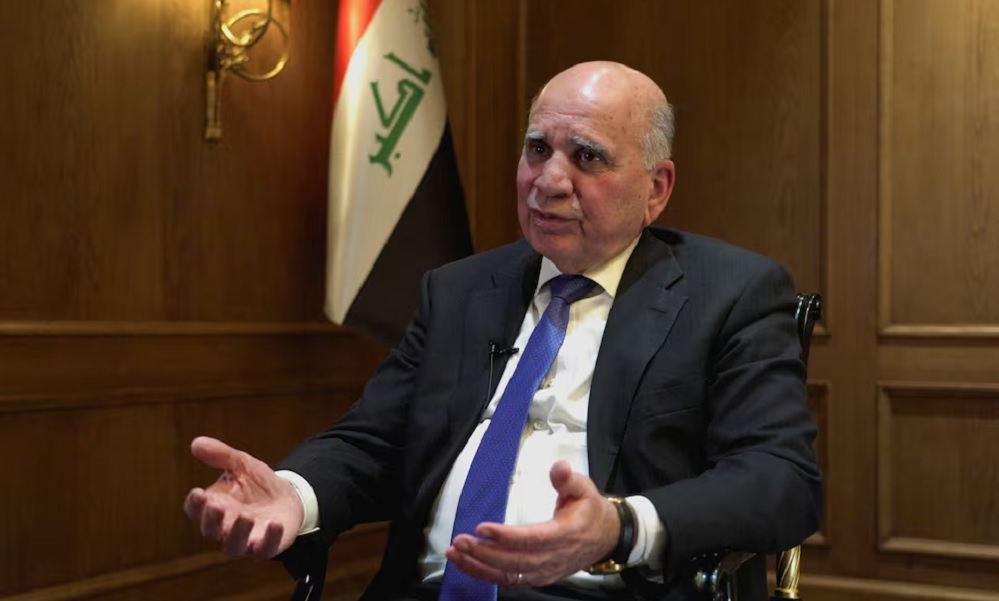
Iraq is trying to convince powerful armed factions in the country that have fought U.S. forces and fired rockets and drones at Israel to lay down their weapons or join official security forces, Foreign Minister Fuad Hussein said.
The push comes with a backdrop of seismic shifts in the Middle East that have seen Iran’s armed allies in Gaza and Lebanon heavily degraded and Syria’s government overthrown by rebels, Reuters reported.
Iraq is trying to convince powerful armed factions in the country that have fought U.S. forces and fired rockets and drones at Israel to lay down their weapons or join official security forces, Foreign Minister Fuad Hussein said.
The push comes with a backdrop of seismic shifts in the Middle East that have seen Iran’s armed allies in Gaza and Lebanon heavily degraded and Syria’s government overthrown by rebels.
The incoming U.S. Trump administration promises to pile more pressure on Tehran, which has long backed a number of political parties and an array of armed factions in Iraq.
Some Baghdad officials are concerned the status quo there may be upended next, but Hussein played this down in an interview with Reuters during an official visit to London.
“We don’t think that Iraq is the next,” Hussein said.
The government was in talks to rein in the groups while continuing to walk the tightrope between its ties to both Washington and Tehran, he said.
Iraq’s balancing act has been tested by Iran-backed Iraqi armed groups’ attacks on Israel and on U.S. troops in the country they say are in solidarity with Palestinians during the Israel-Hamas war.
A promised Gaza ceasefire has the government breathing a sight of relief, though uncertainty prevails over how the country may fare after Donald Trump becomes U.S. president.
During the last Trump presidency, relations grew tense as he ordered the assassination of Iranian General Qassem Soleimani in Baghdad in 2020, leading to an Iranian ballistic missile attack on an Iraqi base housing U.S. forces.
“We hope that we can continue this good relationship with Washington,” Hussein said. “It is too early now to talk about which policy President Trump is going to follow for Iraq or Iran.”
With Iraq trying to chart a diplomatic third-way, Hussein said Baghdad was ready to help diffuse tensions between Washington and Tehran if asked and noted previous mediation between Saudi Arabia and Iran that paved the way for their normalization of relations in 2023.
SYRIA
Armed revolution in neighbouring Syria has been viewed with concern.
The Islamist rebels now in power in Damascus were among the Sunni Muslim militants that entered Shia-majority Iraq from Syria after the 2003 U.S.-led invasion, fuelling years of sectarian war.
Islamic State crossed the same way a decade later and undertook bloody massacres before being beaten back by a U.S.-led international military coalition and Iraqi security forces and Iran-aligned factions.
Iraq will only be reassured about Syria when it sees an inclusive political process, Hussein said, adding Baghdad would supply the country with grain and oil once it could be assured it would go to all Syrians.
Baghdad was in talks with Syria’s foreign minister over a visit to Iraq, he said.
“We are worried about the ISIS, so we are in contact with the Syrian side to talk about these things, but at the end to have a stable Syria means to have the representative of all components in the political process.”
Baghdad and Washington last year agreed to end the U.S-led coalition’s work by September 2026 and transition to bilateral military ties, but Hussein said that the developments in Syria would have to be watched.
“In the first place, we are thinking about security of Iraq and stability in Iraq. If there will be a threat to our country, of course it will be a different story,” he said.
“But until this moment we don’t see a threat.”







Regional
Imran Khan calls for street movement, urges public to reclaim rights
Khan has appealed for collective action, saying the movement was necessary to restore the rule of law, ensure justice, and end what he described as politically motivated and pre-determined court decisions.
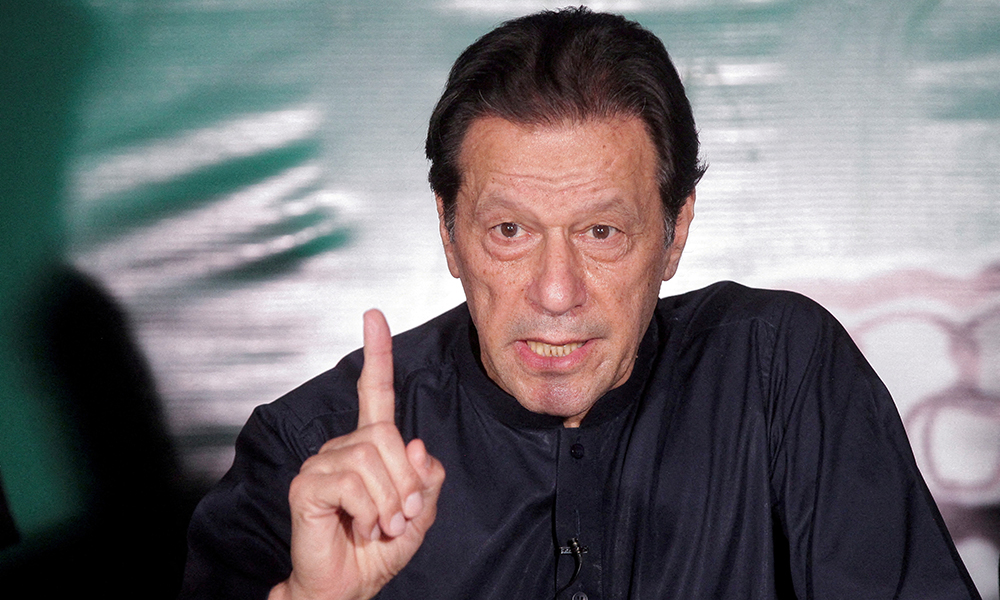
Former Pakistani Prime Minister Imran Khan has called on his supporters and the wider public to prepare for a nationwide street movement, urging citizens to rise in defense of their fundamental rights.
In a message issued from Adiala Jail, where he is currently detained, Khan appealed for collective action, saying the movement was necessary to restore the rule of law, ensure justice, and end what he described as politically motivated and pre-determined court decisions.
Khan said the recent verdict against him was part of sustained political pressure, alleging that the ruling was delivered without due legal process and without giving him a fair opportunity to present his defense. He warned that such practices have severely damaged the credibility of Pakistan’s judicial system.
The former prime minister also called on lawyers, constitutional experts, and members of the legal community to stand with the public and play an active role in safeguarding the Constitution and the rule of law. He said political stability and economic progress were impossible without an independent and impartial judiciary.
Addressing civil-military relations, Khan said his criticism was aimed at individuals rather than institutions. He described the military as belonging to the people of Pakistan, while alleging that actions taken against him in detention were carried out on the instructions of military authorities.
Khan drew comparisons with the 2007 political crisis, warning that continued erosion of the rule of law would have lasting consequences for the country. He praised judges who resist pressure as national heroes and criticized those who, he said, follow orders without question.
The statement comes amid heightened political and judicial tensions in Pakistan, with Khan’s trial and detention continuing to draw strong domestic and international attention.
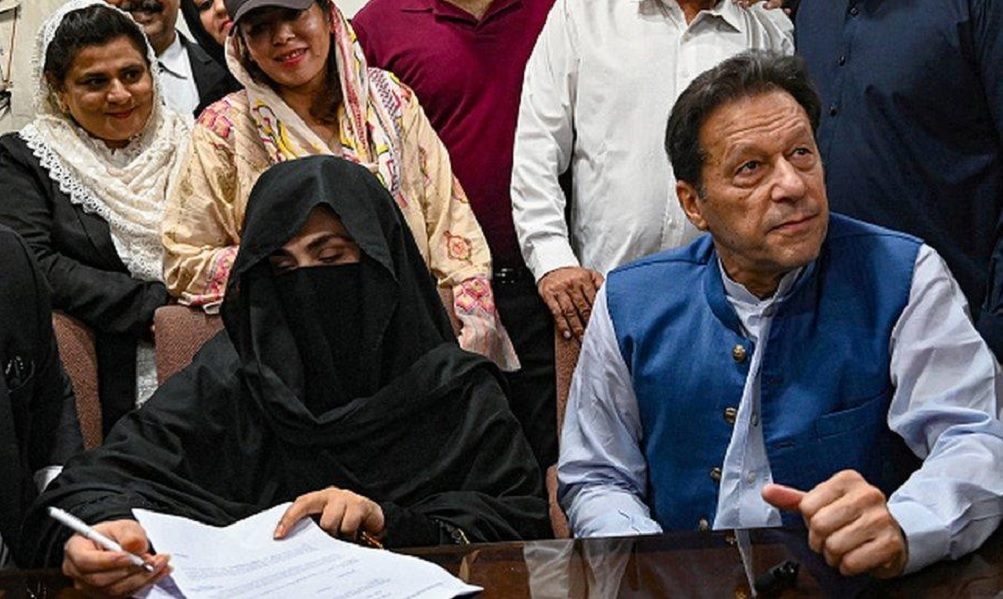
A Pakistani court on Saturday sentenced former Prime Minister Imran Khan and his wife Bushra Bibi to 17 years in prison each in a corruption case involving the under-priced purchase of luxury state gifts, the court and Khan’s lawyers said.
The latest conviction adds to a series of legal troubles for Khan, who has been behind bars since August 2023, and is currently serving a 14-year sentence in a separate land graft case, Reuters reported.
He faces dozens of cases filed since he was ousted from office in 2022, ranging from corruption to anti-terrorism and state secrets charges. Khan has denied wrongdoing in all the cases, which his party says are politically motivated.
“The court announced the sentence without hearing the defence and sentenced 17 years imprisonment to Imran Khan and Bushra Bibi with heavy fines,” Khan’s family lawyer Rana Mudassar Umer told Reuters.
They were handed 10 years’ rigorous imprisonment under Pakistan’s penal code for criminal breach of trust and a further seven years under anti-corruption laws, the special court of Pakistan’s Federal Investigation Agency said in its verdict.
He faces dozens of cases filed since he was ousted from office in 2022, ranging from corruption to anti-terrorism and state secrets charges. Khan has denied wrongdoing in all the cases, which his party says are politically motivated.
“The court announced the sentence without hearing the defence and sentenced 17 years imprisonment to Imran Khan and Bushra Bibi with heavy fines,” Khan’s family lawyer Rana Mudassar Umer told Reuters.
They were handed 10 years’ rigorous imprisonment under Pakistan’s penal code for criminal breach of trust and a further seven years under anti-corruption laws, the special court of Pakistan’s Federal Investigation Agency said in its verdict.
Khan’s jail term from Saturday’s ruling would begin after he has served the 14 years from the land graft case, Information Minister Attaullah Tarar said.
The case relates to luxury watches gifted to Khan by Saudi Arabia’s Crown Prince Mohammed bin Salman during official visits, which prosecutors said Khan and his wife then purchased from the state at a heavily discounted price in violation of Pakistan’s gift rules.
Tarrar said the purchase resulted in losses of several million rupees for the state.
Zulfi Bukhari, a spokesperson for Khan, said the verdict “ignores basic principles of justice” and turns the process into “a tool for selective prosecution.”
Khan has told his legal team to appeal the decision at the Islamabad High Court, Salman Safdar, another one of his lawyers, told reporters outside the jail where the trials were being held, Geo News reported.
ANOTHER STATE GIFTS CONVICTION
The case is separate from an earlier state gifts prosecution linked to Khan’s August 2023 arrest. Earlier sentences of 14 years for Khan and seven years for Bushra Bibi were later suspended on appeal. The couple denies wrongdoing.
The cases are commonly known in Pakistan as the Toshakhana cases, referring to the state repository where gifts received by public officials are deposited.
Following the verdict, Khan’s Pakistan Tehreek-e-Insaf (PTI) party announced plans for protests across Punjab on Sunday.
Khan’s party also says routine family and legal visits have been blocked in recent weeks despite court orders. Authorities deny any mistreatment and say he is receiving all facilities available to prisoners.
Khan, a former cricket star turned politician, remains one of Pakistan’s most polarising figures, with his legal battles unfolding as his Pakistan Tehreek-e-Insaf party remains sidelined from power.
Regional
Pakistan’s military chief Asim Munir in spotlight over Trump’s Gaza plan
Munir was earlier this month anointed chief of the defence forces to head the air force and navy as well, with a job extension until 2030.
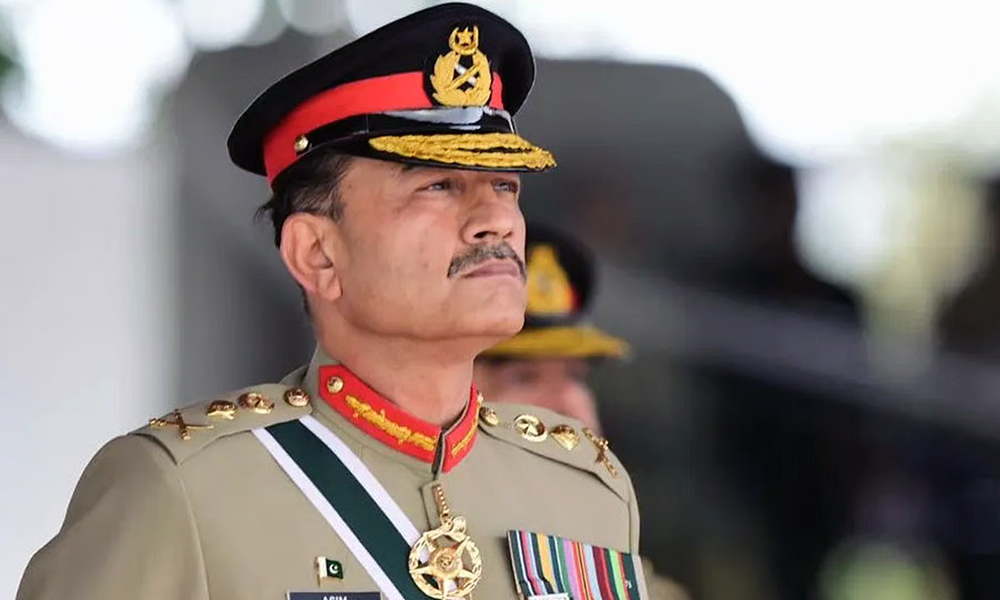
Pakistan’s most powerful military chief in decades faces the toughest test of his newly amassed powers as Washington pushes Islamabad to contribute troops to the Gaza stabilisation force, a move analysts say could spark domestic backlash.
Field Marshal Asim Munir is expected to fly to Washington to meet President Donald Trump in the coming weeks for a third meeting in six months that will likely focus on the Gaza force, two sources told Reuters, one of them a key player in the general’s economic diplomacy.
Trump’s 20-point Gaza plan calls for a force from Muslim nations to oversee a transition period for reconstruction and economic recovery in the war-torn Palestinian territory, decimated by over two years of Israeli military bombardment.
Many countries are wary of the mission to demilitarise Gaza’s Islamist militant group Hamas, which could drag them into the conflict and enrage their pro-Palestinian and anti-Israeli populations.
But Munir has built a close relationship with the mercurial Trump to repair years of mistrust between Washington and Islamabad. In June, he was rewarded with a White House lunch – the first time a U.S. president hosted Pakistan’s army chief alone, without civilian officials.
“Not contributing (to the Gaza stabilisation force) could annoy Trump, which is no small matter for a Pakistani state that appears quite keen to remain in his good graces – in great part to secure U.S. investment and security aid,” said Michael Kugelman, Senior Fellow, South Asia at Washington-based Atlantic Council.
Pakistan, the world’s only Muslim country with nuclear weapons, has a battle-hardened military having gone to war with arch-rival India three times and a brief conflict this summer.
It has also tackled insurgencies in its far-flung regions and is currently embroiled in a bruising war with Islamist militants who it says are operating from Afghanistan.
Pakistan’s military strength means “there is a greater pressure on Munir to deliver his capacity,” said author and defence analyst Ayesha Siddiqa.
Pakistan’s military, foreign office and information ministry did not respond to questions from Reuters. The White House also did not respond to a request for a comment.
Pakistani Foreign Minister Ishaq Dar said last month that Islamabad could consider contributing troops for peacekeeping but disarming Hamas “is not our job.”
Munir was earlier this month anointed chief of the defence forces to head the air force and navy as well, with a job extension until 2030.
He will retain his field marshal title forever, as well as enjoy lifetime immunity from any criminal prosecution under the constitutional amendments that Pakistan’s civilian government pushed through parliament late last month.
“Few people in Pakistan enjoy the luxury of being able to take risks more than Munir. He has unbridled power, now constitutionally protected,” Kugelman added.
“Ultimately, it will be Munir’s rules, and his rules only.”
Over the past few weeks, Munir has met military and civilian leaders from countries such as Indonesia, Malaysia, Saudi Arabia, Turkey, Jordan, Egypt and Qatar, according to the military’s statements, which Siddiqa said appeared to be consultations on the Gaza force.
But the big concern at home is that the involvement of Pakistan troops in Gaza under a U.S.-backed plan could re-ignite protests from Pakistan’s Islamist parties that are deeply opposed to the U.S. and Israel.
The Islamists have street power to mobilise thousands.
A powerful and violent anti-Israel Islamist party that fights for upholding Pakistan’s ultra-strict blasphemy laws was banned in October.
Authorities arrested its leaders and over 1,500 supporters and seized its assets and bank accounts in an ongoing crackdown, officials said.
While Islamabad has outlawed the group, its ideology is still alive.
The party of former jailed premier, Imran Khan, whose supporters won the most seats in the 2024 national elections and has wide public support, also has an axe to grind against Munir.
Abdul Basit, Senior Associate Fellow, S. Rajaratnam School of International Studies in Singapore, said if things escalated once the Gaza force was on the ground, it would cause problems quickly.
“People will say ‘Asim Munir is doing Israel’s bidding’ – it will be foolhardy of anyone not to see it coming.”


Tahawol: Return of 6.8 million Afghan refugees to IEA rule

Saar: Pakistan army chief’s allegations against Afghanistan

Turkish intelligence captures a Daesh member near the Durand Line

Dozens of needy families in Kabul receive winter aid from Bayat Foundation

Nearly seven million Afghan refugees return home since Islamic Emirate’s takeover

Afghanistan economy under pressure as Pakistan shocks reshape trade flows

Gaza death toll tops 70,000, health ministry says

Afghanistan offers tax breaks, free land to attract Indian investors

Iran rerouting more oil to China through Indonesia to dodge US sanctions

Islamic Emirate declines to attend Tehran meeting on Afghanistan
Tahawol: Return of 6.8 million Afghan refugees to IEA rule
Saar: Pakistan army chief’s allegations against Afghanistan

Tahawol: CSTO’s security concerns over Afghanistan

Saar: UNAMA’s activities in Afghanistan reviewed

Tahawol: Iran’s pledges to facilitate trade with Afghanistan discussed
-
 Latest News3 days ago
Afghan border forces prevent illegal entry of hundreds into Iran
-
 Latest News3 days ago
Pakistan summons Afghan diplomat over deadly attack in North Waziristan
-
 Latest News1 day ago
Afghanistan signs 30-year deal for marble mining in Daikundi
-
 Latest News2 days ago
Afghan health minister calls for medical cooperation between Kabul and New Delhi
-

 Latest News3 days ago
Japan allocates nearly $20 million in humanitarian aid for Afghanistan
-
 Latest News3 days ago
Karzai urges reopening of girls’ schools and universities for Afghanistan’s bright future
-
 Health5 days ago
Afghanistan seeks India’s support in standardizing traditional medicine
-
 World5 days ago
US readies new Russia sanctions if Putin rejects peace deal, Bloomberg News reports