
World
Heeding complaints, Biden lifts refugee cap to 62,500

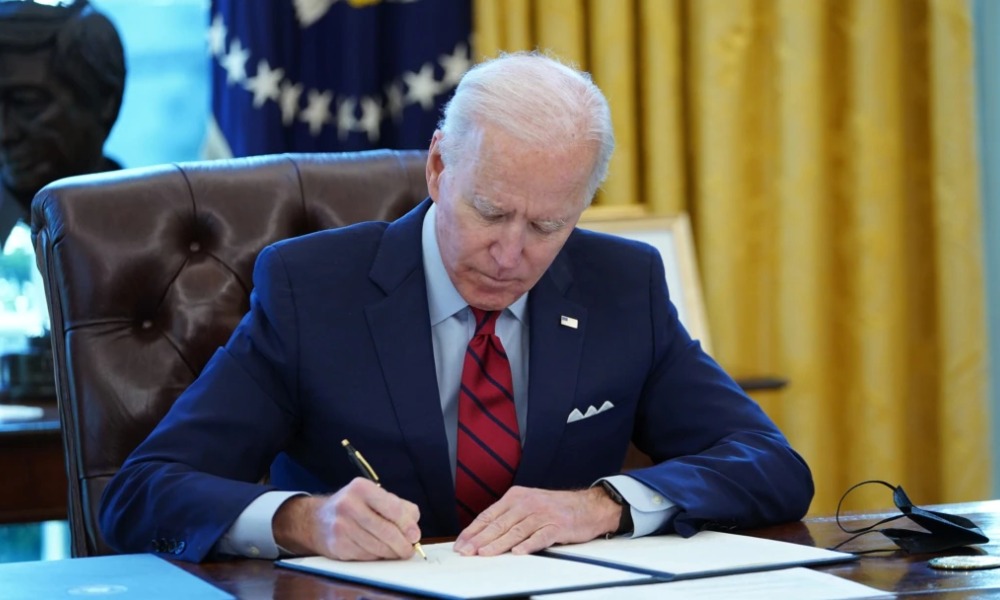
U.S. President Joe Biden said on Monday he has resurrected a plan to raise refugee admissions this year to 62,500 after drawing a wave of criticism from supporters for initially keeping the refugee cap at a historically low level.
A Democrat, Biden formally reversed himself just two weeks after his administration announced it would keep the cap at the 15,000 level set by his Republican predecessor, Donald Trump, an immigration hawk.
In a statement, Biden said his action “erases the historically low number set by the previous administration of 15,000, which did not reflect America’s values as a nation that welcomes and supports refugees.”
“It is important to take this action today to remove any lingering doubt in the minds of refugees around the world who have suffered so much, and who are anxiously waiting for their new lives to begin,” he said.
Soon after taking office in January, Biden pledged to ramp up the program but then surprised allies when he opted to stick with the lower cap out of concern over bad optics, given the rising number of migrants crossing the U.S. southern border with Mexico, U.S. officials have said.
Biden’s flip-flopping drew the ire of refugee advocates and some Democratic lawmakers.
Trump steadily slashed the size of the refugee program during his term in office, and Biden officials say the cuts have made quickly raising admissions more difficult.
But the refugee program is distinct from the asylum system for migrants. Refugees come from all over the world, many fleeing conflict. They undergo extensive vetting while still overseas to be cleared for entry to the United States, unlike migrants who arrive at a U.S. border and then request asylum.
The allocations for the increased cap matched an earlier plan Biden sent to Congress, according to a memo signed by Biden. The memo said there would be 22,000 spots for refugees from Africa, 6,000 from East Asia, 4,000 from Europe and Central Asia, 5,000 from Latin America and the Caribbean, and 13,000 from South Asia. Another 12,500 unallocated spots will also be available.
Biden said it was doubtful the United States would be able to welcome a total of 62,500 refugees by the end of the current fiscal year on Sept. 30, or reach a goal of 125,000 admissions next year.
“The sad truth is that we will not achieve 62,500 admissions this year. We are working quickly to undo the damage of the last four years. It will take some time, but that work is already under way,” he said.
A White House official said Biden now wanted to raise the cap regardless of capacity limitations to “send a very clear message that refugee processing is a critical part of America’s place in the world,” acknowledging the initial lower announcement “did not send the right message.”
Delays in Biden’s decisionmaking on the issue led to hundreds of canceled flights for refugees already cleared to travel to the United States, often after years of waiting, refugee groups said.
Krish O’Mara Vignarajah, president of the resettlement organization Lutheran Immigration and Refugee Service, said in a statement that advocacy groups were breathing a “sigh of relief” following the announcement on Monday, even though meeting the high target would be “daunting.”







World
US hosts rare Israel-Lebanon talks, progress unclear
The U.S. State Department released a statement after the meeting saying the two sides had “productive discussions on steps toward launching direct negotiations.”
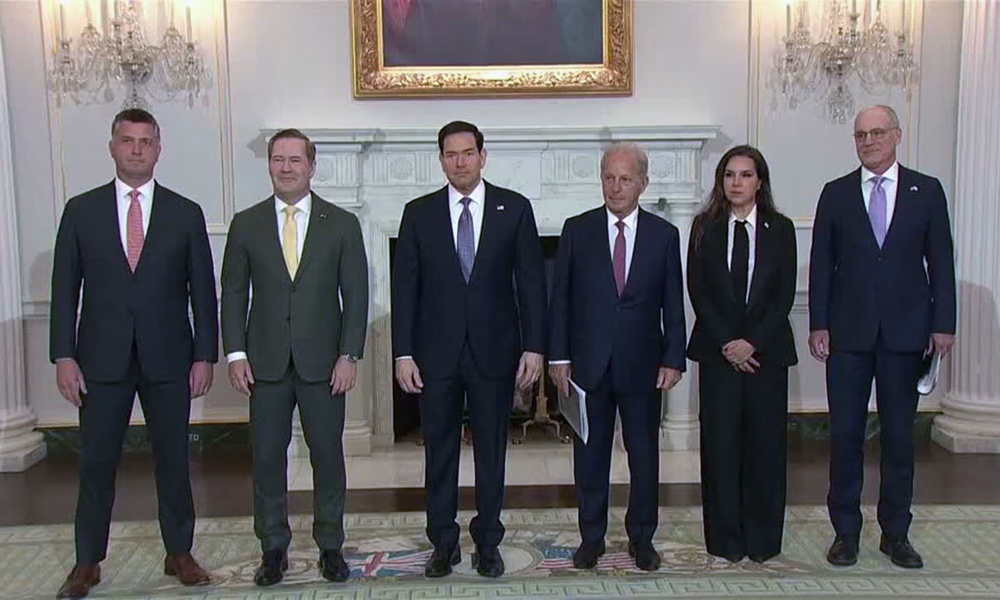
U.S. Secretary of State Marco Rubio hosted the first direct talks between Israel and Lebanon in decades on Tuesday and both sides said they held positive discussions although it was not immediately clear if they agreed to a framework for peace, Reuters reported.
The meeting marked a rare encounter between representatives of governments that have technically been in a state of war since Israel was established in 1948. They entered the talks with conflicting agendas, with Israel ruling out discussion of a ceasefire in Lebanon and demanding Beirut disarm Hezbollah.
The U.S. State Department released a statement after the meeting saying the two sides had “productive discussions on steps toward launching direct negotiations.”
It set out each country’s positions but did not say they had reached any common ground. “All sides agreed to launch direct negotiations at a mutually agreed time and venue,” the statement said.
Speaking to reporters after the more than two-hour-long meeting in Washington, Yechiel Leiter, Israeli ambassador to the United States, said the Lebanese government made it clear during the talks that it will no longer be “occupied” by Iran-aligned Lebanese militia Hezbollah. He declined to say whether Israel would cease its attacks on Lebanon.
Lebanese ambassador Nada Moawad described the preliminary meeting as “constructive”. In a statement to Reuters, she said in the meeting she called for a ceasefire and the return of displaced people to their homes and measures to alleviate the humanitarian crisis in Lebanon caused by the conflict.
The meeting comes at a critical juncture in the crisis in the Middle East, a week into a fragile ceasefire between the United States, Israel and Iran.
The wider conflict in the region began with U.S.-Israeli strikes on Iran on February 28. Hezbollah opened fire in support of Tehran on March 2, sparking an Israeli offensive that has killed more than 2,000 people and forced 1.2 million from their homes, according to Lebanese authorities.
The presence of Rubio, President Donald Trump’s top diplomat and national security adviser, signalled Washington’s desire to see progress.
Trump has urged Israel to scale back attacks in Lebanon apparently to avoid undermining the ceasefire between the U.S. and Iran. The Middle East conflict has led to the largest oil supply disruption in history, piling pressure on Trump to find an off-ramp, read the report.
Iran says Israel’s campaign against Hezbollah in Lebanon must be included in any agreement to end the wider war in the Middle East, complicating talks mediated by Pakistan aimed at averting further economic fallout. Washington has pushed back, saying there is no link between the two sets of talks.
Speaking at the start of the meeting, Rubio acknowledged that Tuesday’s talks would not solve “all of the complexities” but he hoped they would help form a framework for peace.
Israeli ambassador Leiter later expressed hope but did not mention a concrete way forward.
“What gives me hope is the fact that the Lebanese Government made it very clear that they will no longer be occupied by Hezbollah… This is an opportunity. This is the first time our two countries are sitting together in over three decades,” Leiter said, adding that there may be further talks in the coming weeks.
The Lebanese government led by President Joseph Aoun and Prime Minister Nawaf Salam has called for negotiations with Israel despite objections from Hezbollah, reflecting worsening tensions between the Shi’ite Muslim group and its opponents.
The Lebanese state has been seeking to disarm Hezbollah peacefully since a war between the militia and Israel in 2024. Any move by Lebanon to disarm it by force risks igniting conflict in a country shattered by civil war from 1975 to 1990. Moves against Hezbollah by a Western-backed government in 2008 prompted a short civil war.
The current government banned Hezbollah’s military wing after it opened fire on Israel last month.
Lebanese officials have said Moawad only has authority to discuss a ceasefire in Tuesday’s meeting while Israeli government spokesperson Shosh Bedrosian said Israel would not discuss a ceasefire, underscoring how at odds the two sides are.
In earlier remarks, Rubio said these talks were a process and not a one-off event. Leiter said there may be more talks soon but none of the participants mentioned a set time and a place.
“There were a few proposals, a few recommendations. We will of course bring these recommendations to our governments… and we will return in the next few weeks, we will continue to sit together. We will probably continue the talks in Washington,” Leiter said.
Rubio was hosting Tuesday’s talks amid questions over his lack of in-person participation in talks with Iran, with the Republican president sending Vice President JD Vance to Islamabad over the weekend to lead the U.S. negotiations, read the report.
Rubio was with Trump in Florida watching a mixed martial arts event as Vance announced in Pakistan that talks with the Iranians had concluded with no breakthrough.
State Department Counselor Michael Needham, U.S. ambassador to the United Nations Mike Waltz, and U.S. ambassador to Lebanon Michel Issa, a personal friend of Trump, were also participating in the talks on Tuesday.
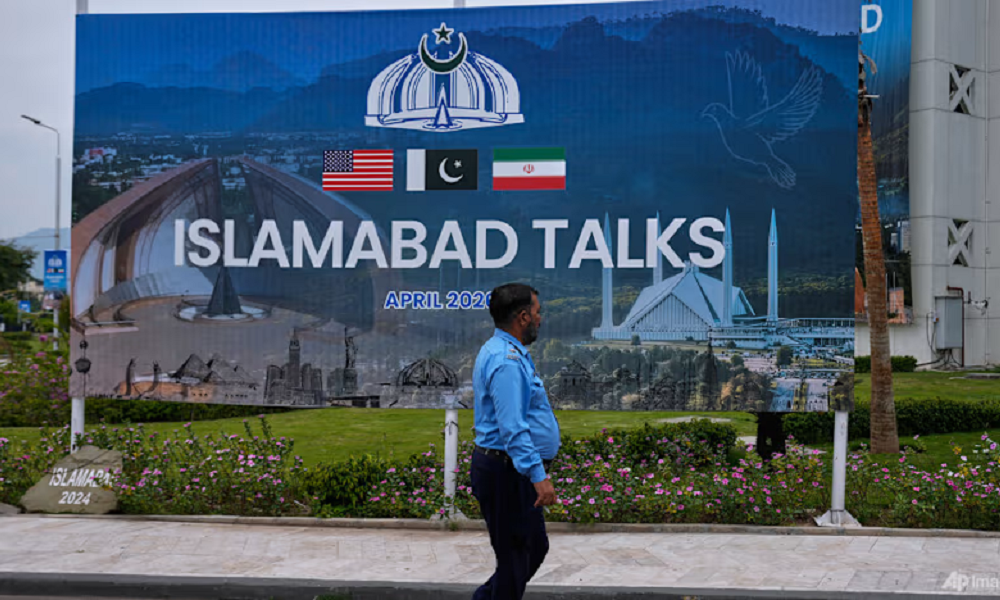
Negotiating teams from the U.S. and Iran could return to Islamabad this week to resume talks to end the war, sources told Reuters on Tuesday, after the collapse of weekend negotiations prompted Washington to impose a blockade on Iranian ports.
While the U.S. blockade drew angry rhetoric from Tehran, signs that diplomatic engagement might continue helped calm oil markets, pushing benchmark prices below $100 on Tuesday.
The highest-level talks between the two adversaries since the 1979 Islamic Revolution ended in the Pakistani capital without a breakthrough at the weekend, raising doubts over the survival of a two-week ceasefire that still has a week to run.
But a source involved in the talks said on Tuesday both countries could return as early as the end of this week, and that a proposal had been shared with Washington and Tehran to resend their delegations.
“No firm date has been set, with the delegations keeping Friday through Sunday open,” a senior Iranian source said.
U.S. President Donald Trump said Iran had been in touch on Monday and wanted to make a deal, adding that he would not sanction any agreement that allowed Tehran to possess a nuclear weapon.
Since the United States and Israel began the war on February 28, Iran effectively shut the Strait of Hormuz to nearly all vessels except its own, saying passage would be permitted only under Iranian control and subject to a fee. The fallout has been widespread, as nearly a fifth of the world’s oil and gas previously flowed through the narrow waterway.
In a countermeasure, the U.S. military said it began blocking shipping traffic in and out of Iran’s ports on Monday.
Tehran has threatened to hit naval ships going through the strait and to retaliate against its Gulf neighbours’ ports.
Nearly 24 hours into the U.S. blockade, there had yet to be reports of Washington taking direct action against shipping to enforce it.
Three Iran-linked tankers were seen transiting the Strait of Hormuz on Tuesday, shipping data showed, but the vessels were not heading to or from Iranian ports.
World
Trump says Iran wants to make a deal
Trump said that talks had hit a roadblock related to nuclear issues and that a “blockade” of ships transiting the Strait of Hormuz had begun.

U.S. President Donald Trump said on Monday that Iran wants to make a deal and that he will not come to any agreement that allows Tehran to have a nuclear weapon, Reuters reported.
Trump said that talks had hit a roadblock related to nuclear issues and that a “blockade” of ships transiting the Strait of Hormuz had begun.
He said that Iran had “called this morning” and that “they’d like to work a deal.” Reuters could not immediately verify the claim.
“Iran will not have a nuclear weapon,” Trump told reporters at the White House. “We can’t let a country blackmail or extort the world.”


Tahawol: Cooperation between Afghanistan and Central Asia discussed

Saar: Calls for recognition of IEA discussed

Iran’s Foreign Minister meets Pakistani Army Chief in Tehran amid mediation efforts

IEA FM discusses recent Kabul–Islamabad talks in China with Saudi ambassador

UN says aid to Afghans remained steady despite funding pressures in 2025

IEA supreme leader orders replacement of foreign terminology in official documents

Russia deems US military presence in Afghanistan unacceptable

Afghanistan hosts inaugural Afghanistan–Central Asia Consultative Dialogue to strengthen regional cooperation

TAPI gas pipeline advances 25 km in Afghanistan

Afghani strengthens nearly 10% against US dollar amid banking sector reforms
Tahawol: Cooperation between Afghanistan and Central Asia discussed
Saar: Calls for recognition of IEA discussed

Tahawol: Calls to strengthen Afghanistan’s border security

Saar: Discussion on UN sanctions list updates on IEA members

Tahawol: Consequences of US blockade on Strait of Hormuz discussed
-

 Sport4 days ago
Afghanistan’s new cricket head coach Richard Pybus arrives in Kabul
-
 Regional4 days ago
Iranian source says US has agreed to unfreeze Iranian funds held in Qatar, other countries
-

 Latest News3 days ago
China establishes new Xinjiang county near sensitive border region
-
 World4 days ago
US, Iran teams in Pakistan for peace talks amid doubts over Lebanon, sanctions
-

 World4 days ago
At least 30 dead in stampede at Haiti’s historic Laferriere Citadel
-
 Latest News4 days ago
Death toll rises in armed attack in Herat; 11 killed, 8 injured
-

 International Sports4 days ago
IPL double-header delivers thrills as teams battle for momentum
-
 Latest News5 days ago
UN warns of deepening humanitarian crisis in Afghanistan, calls for urgent aid