
World
Heeding complaints, Biden lifts refugee cap to 62,500

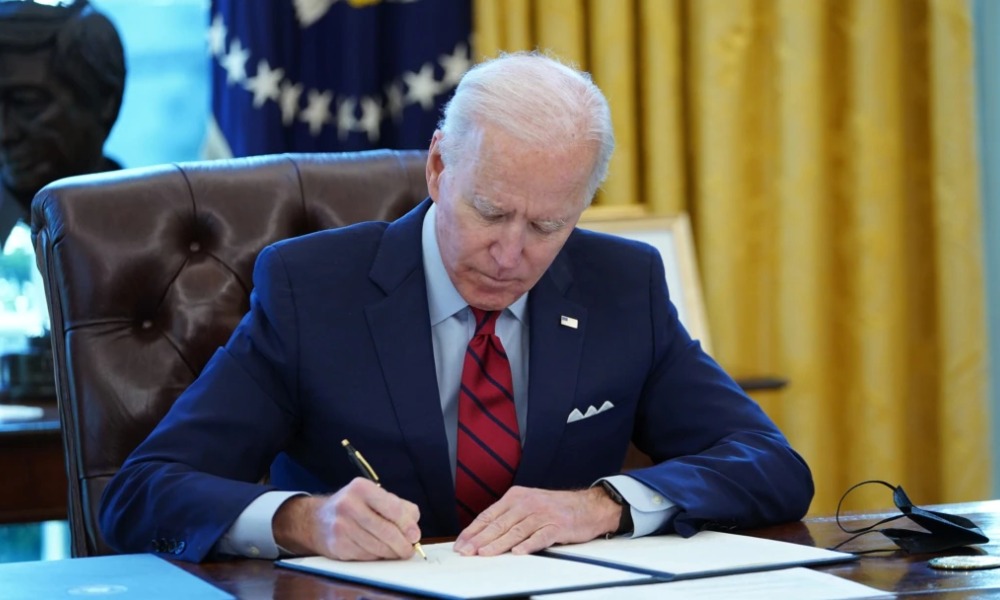
U.S. President Joe Biden said on Monday he has resurrected a plan to raise refugee admissions this year to 62,500 after drawing a wave of criticism from supporters for initially keeping the refugee cap at a historically low level.
A Democrat, Biden formally reversed himself just two weeks after his administration announced it would keep the cap at the 15,000 level set by his Republican predecessor, Donald Trump, an immigration hawk.
In a statement, Biden said his action “erases the historically low number set by the previous administration of 15,000, which did not reflect America’s values as a nation that welcomes and supports refugees.”
“It is important to take this action today to remove any lingering doubt in the minds of refugees around the world who have suffered so much, and who are anxiously waiting for their new lives to begin,” he said.
Soon after taking office in January, Biden pledged to ramp up the program but then surprised allies when he opted to stick with the lower cap out of concern over bad optics, given the rising number of migrants crossing the U.S. southern border with Mexico, U.S. officials have said.
Biden’s flip-flopping drew the ire of refugee advocates and some Democratic lawmakers.
Trump steadily slashed the size of the refugee program during his term in office, and Biden officials say the cuts have made quickly raising admissions more difficult.
But the refugee program is distinct from the asylum system for migrants. Refugees come from all over the world, many fleeing conflict. They undergo extensive vetting while still overseas to be cleared for entry to the United States, unlike migrants who arrive at a U.S. border and then request asylum.
The allocations for the increased cap matched an earlier plan Biden sent to Congress, according to a memo signed by Biden. The memo said there would be 22,000 spots for refugees from Africa, 6,000 from East Asia, 4,000 from Europe and Central Asia, 5,000 from Latin America and the Caribbean, and 13,000 from South Asia. Another 12,500 unallocated spots will also be available.
Biden said it was doubtful the United States would be able to welcome a total of 62,500 refugees by the end of the current fiscal year on Sept. 30, or reach a goal of 125,000 admissions next year.
“The sad truth is that we will not achieve 62,500 admissions this year. We are working quickly to undo the damage of the last four years. It will take some time, but that work is already under way,” he said.
A White House official said Biden now wanted to raise the cap regardless of capacity limitations to “send a very clear message that refugee processing is a critical part of America’s place in the world,” acknowledging the initial lower announcement “did not send the right message.”
Delays in Biden’s decisionmaking on the issue led to hundreds of canceled flights for refugees already cleared to travel to the United States, often after years of waiting, refugee groups said.
Krish O’Mara Vignarajah, president of the resettlement organization Lutheran Immigration and Refugee Service, said in a statement that advocacy groups were breathing a “sigh of relief” following the announcement on Monday, even though meeting the high target would be “daunting.”







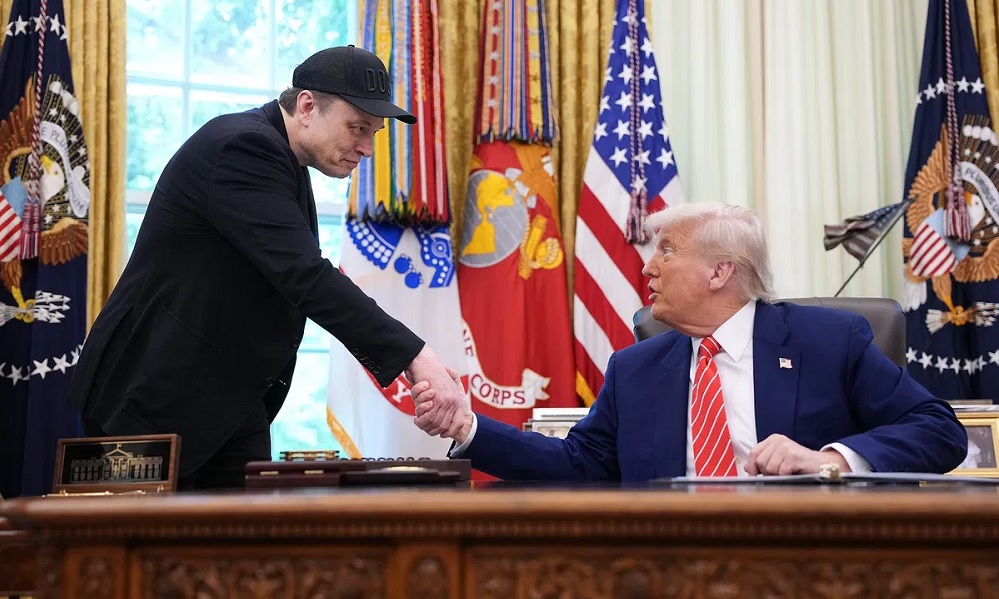
U.S. President Donald Trump said on Sunday he plans to speak with billionaire Elon Musk about restoring internet in Iran, where authorities have blacked out services for four days amid ongoing anti-government protests.
“He’s very good at that kind of thing, he’s got a very good company,” Trump told reporters in response to a question about whether he would engage with Musk’s SpaceX company, which offers a satellite internet service called Starlink that has been used in Iran, Reuters reported.
Musk and SpaceX did not immediately respond to a request for comment.
The flow of information from Iran has been hampered by an internet blackout since Thursday amid the most expansive protests against the country’s clerical establishment since 2022.
Musk and Trump have held an on-again, off-again relationship after the billionaire helped fund Trump’s winning presidential campaign and subsequently orchestrated massive cuts to the federal government.
The pair had a public falling-out last year as Musk opposed Trump’s signature tax bill, but the entrepreneur appears to have rekindled his relationship with the Trump administration. Musk and Trump were seen dining together at Trump’s Mar-a-Lago resort this month, and Secretary of Defense Pete Hegseth is scheduled to visit a SpaceX facility in Texas on Monday.
Musk has supported providing Starlink to Iranians to help them circumvent the government’s restrictions, including amid previous protests in 2022. That year, the Biden White House engaged with Musk to set up Starlink in Iran after the country was engulfed by protests following the death in police custody of 22-year-old Mahsa Amini.
The Starlink satellite service has been used in other regions marked by unrest or conflict such as Ukraine, where Musk in 2022 ordered a shutdown of Starlink during a pivotal Ukrainian offensive, Reuters reported.
Iran’s current protests began on December 28 in response to soaring prices, before turning against the clerical rulers who have governed since the 1979 Islamic Revolution.
Hundreds of people have been killed since then, rights groups estimate. U.S.-based organization HRANA said it has verified the deaths of 490 protesters and 48 security personnel, with more than 10,600 people arrested in two weeks of unrest. Iran has not given an official toll and Reuters was unable to independently verify the tolls.

Israel is on high alert for the possibility of any U.S. intervention in Iran as authorities there confront the biggest anti-government protests in years, Reuters reported citing three Israeli sources with knowledge of the matter.
President Donald Trump has repeatedly threatened to intervene in recent days and warned Iran’s rulers against using force against demonstrators. On Saturday, Trump said the U.S. stands “ready to help”, Reuters reported.
The sources, who were present for Israeli security consultations over the weekend, did not elaborate on what Israel’s high-alert footing meant in practice. Israel and Iran fought a 12-day war in June, in which the U.S. joined Israel in launching airstrikes.
In a phone call on Saturday, Israeli Prime Minister Benjamin Netanyahu and U.S. Secretary of State Marco Rubio discussed the possibility of U.S. intervention in Iran, according to an Israeli source who was present for the conversation. A U.S. official confirmed the two men spoke but did not say what topics they discussed.
Israel has not signalled a desire to intervene in Iran as protests grip the country, with tensions between the two arch-foes high over Israeli concerns about Iran’s nuclear and ballistic missile programmes.
In an interview with the Economist published on Friday, Netanyahu said there would be horrible consequences for Iran if it were to attack Israel. Alluding to the protests, he said: “Everything else, I think we should see what is happening inside Iran.”
World
China, Russia, Iran start ‘BRICS Plus’ naval exercises in South African waters
The expanded BRICS group also includes Egypt, Indonesia, Saudi Arabia, Ethiopia and the United Arab Emirates.
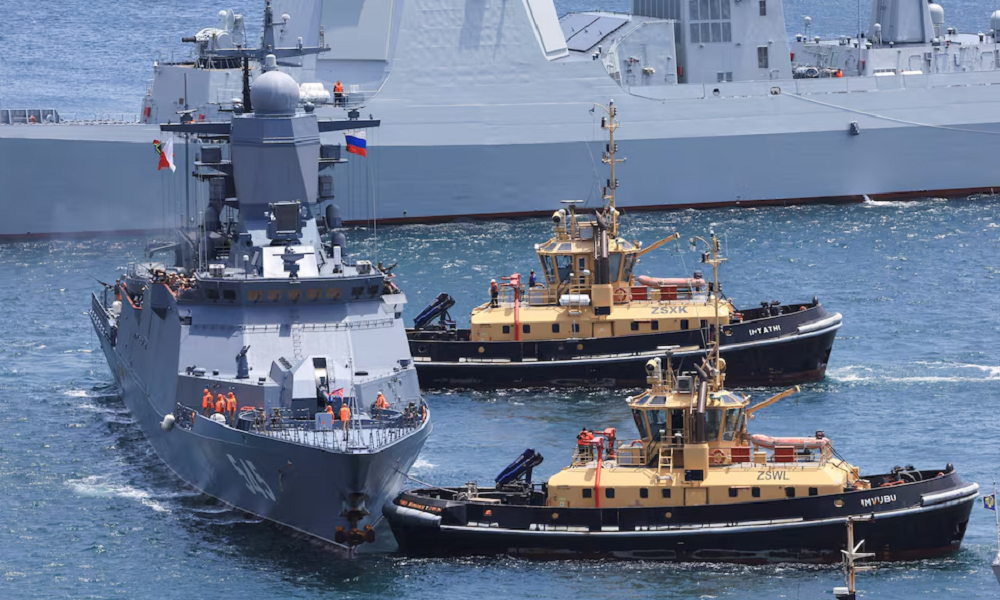
China, Russia and Iran began a week of joint naval exercises in South Africa’s waters on Saturday in what the host country described as a BRICS Plus operation to “ensure the safety of shipping and maritime economic activities”.
BRICS Plus is an expansion of a geopolitical bloc originally comprising Brazil, Russia, India, China and South Africa – and seen by members as a counterweight to U.S. and Western economic dominance – to include six other countries.
Though South Africa routinely carries out naval exercises with China and Russia, it comes at a time of heightened tensions between U.S. President Donald Trump’s administration and several BRICS Plus countries, including China, Iran, South Africa and Brazil.
The expanded BRICS group also includes Egypt, Indonesia, Saudi Arabia, Ethiopia and the United Arab Emirates.
Chinese military officials leading the opening ceremony said Brazil, Egypt and Ethiopia participated as observers.
“Exercise WILL FOR PEACE 2026 brings together navies from BRICS Plus countries for … joint maritime safety operations (and) interoperability drills,” South Africa’s military said in a statement.
Lieutenant Colonel Mpho Mathebula, acting spokesperson for joint operations, told Reuters all members had been invited.
Trump has accused the BRICS nations of pursuing “anti-American” polities, and last January threatened all members with a 10% trade tariff on top of duties he was already imposing on countries across the world.
The pro-Western Democratic Alliance, the second largest party in South African President Cyril Ramaphosa’s coalition, said the exercises “contradict our stated neutrality” and that BRICS had “rendered South Africa a pawn in the power games being waged by rogue states on the international stage”.
Mathebula rejected that criticism.
“This is not a political arrangement … there is no hostility (towards the U.S.),” Mathebula told Reuters, pointing out that South Africa has also periodically carried out exercises with the U.S. Navy.
“It’s a naval exercise. The intention is for us to improve our capabilities and share information,” she said.


Japan donates $240,000 to support health services in Afghanistan

Afghanistan Under‑19s beat Australia by 6 wickets in World Cup warm‑up match

Afghan student found dead in India

Trump says weighing tough response to Iran crackdown, says Tehran called to negotiate

IEA’s Supreme Leader issues decree on jurisdiction of specialized court for usurped lands

Afghanistan exports 10 containers of batteries to Saudi Arabia and UAE for first time

Pakistani cleric condemns lifetime immunity for Army Chief as un-Islamic

Turkey withdraws from Afghanistan-Pakistan mediation amid rising tensions

Afghanistan signs 30-year deal for marble mining in Daikundi

Sharp drop in exports to Afghanistan drives Pakistan’s trade deficit surge

Tahawol: Iran’s ongoing crisis and its consequences discussed

Saar: Origins and consequences of poverty in Afghanistan discussed

Tahawol: UNICEF’s call for supporting Afghan children’s education

Saar: Discussion on ongoing protests in Iran

Tawsia: Boost in Afghanistan’s imports and exports discussed
-
 Latest News4 days ago
Turkey withdraws from Afghanistan-Pakistan mediation amid rising tensions
-
 Latest News2 days ago
ICG report says Pakistan most impacted by IEA’s return in Afghanistan
-

 Latest News4 days ago
Pakistan says diplomatic channels with Afghanistan open, seeks written assurances against terrorism
-

 Business4 days ago
Air cargo seen as key to boosting Indo-Afghan trade via Amritsar airport
-
 Business3 days ago
Pakistan–Afghanistan bilateral trade plunges 53% in first half of fiscal year
-

 Latest News2 days ago
Health Ministry holds meeting on halting medicine imports from Pakistan
-

 Sport4 days ago
Afghanistan climbs FIFA rankings ahead of AFC Futsal Asian Cup 2026
-
 Latest News4 days ago
Fear of deportation turns deadly for Afghan refugees in Pakistan