
Business
Direct flights between Afghanistan-China resume after three years


Direct flights between Afghanistan and China resumed on Wednesday when an Ariana Airlines plane left Kabul for Urumqi, China.
Officials of the Ministry of Transport and Aviation say that the start of direct flights between Afghanistan and China will have a positive effect on the country’s economic and trade relations.
The head of Ariana Airlines Rahmatullah Aghan says that the company plans to purchase more planes in the near future.
The head of the Afghanistan Chamber of Commerce and Investment Mohmmad Younos Mohmmand says that the Islamic Emirate will create a trade market for the Chinese in Afghanistan.
The Chinese consul general in Kabul said that economic and trade relations with Afghanistan are developing day by day.
He added that the level of trade between the two countries is more than one billion dollars annually and there are good opportunities for Afghan businessmen in China. He also said facilities have been created in Afghanistan for Chinese businessmen and investors.
However, the officials of the Chinese embassy in Kabul say that currently the amount of trade between Afghanistan and China reaches one billion US dollars.
The consul of the Chinese Embassy in Kabul, says that: “We resumed the flight from Kabul to Urumqi, and I see this as progress in Afghanistan-China relations, which both countries are committed to further strengthening.”
This Chinese diplomat adds that in the meeting of the foreign ministers of China, Pakistan and Afghanistan held in Islamabad, it was emphasized on the development of economic relations with Afghanistan and the strengthening of trade cooperation and the connection of Afghanistan, as well as the initiation of infrastructure projects in cooperation with the countries of the region, and it was also agreed that Trade relations between these three countries should be further strengthened.







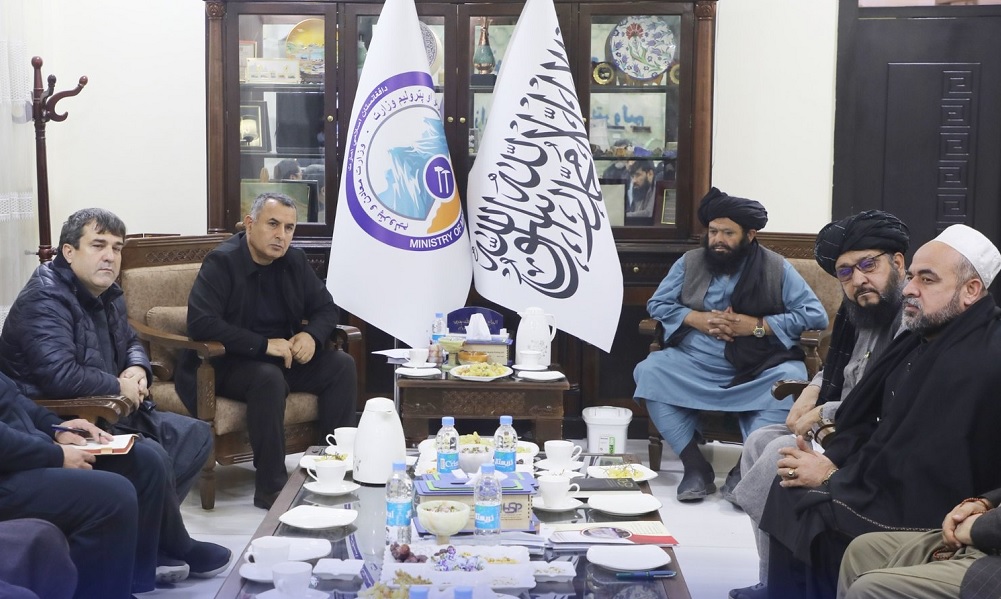
A delegation of Tajikistani investors has expressed interest in establishing a cement production factory in Afghanistan, signaling renewed economic engagement between the two neighbors after four years of limited activity.
The delegation met with Hedayatullah Badri, Afghanistan’s Minister of Mines and Petroleum, to discuss potential investment opportunities in the country’s mining and industrial sectors. Officials said the visit reflects Tajikistan’s increasing willingness to expand economic cooperation with Afghanistan.
During the meeting, the Tajik investors praised the Islamic Emirate for what they described as improved security and a more conducive investment environment across Afghanistan.
Minister Badri welcomed the investors’ proposal and assured them of the government’s full support, emphasizing that Afghanistan is ready to facilitate investment through streamlined procedures and favorable conditions.
Representatives of Afghanistan’s private sector also view the development as a positive step toward strengthening bilateral economic ties.
Abdul Jabbar Safi, head of the Afghanistan Industries Association, said:
“After four years, Tajikistan is looking to take part in Afghanistan’s economic sector. This is encouraging news for the governments and the people of both countries.”
Economic experts believe that deeper economic engagement between Afghanistan and Tajikistan could unlock significant mutual benefits.
Nazir Ahmad Khalil, an economic analyst, said: “Tajikistan and Afghanistan share language, culture and geography. Expanding trade and investment between the two countries can meaningfully improve their economic situations. Building trust will be essential for long-term cooperation, and such investment can play a major role in poverty reduction and confidence-building.”
This new chapter of economic cooperation between Afghanistan and Tajikistan comes at a time when, since the return of the Islamic Emirate to power, several major projects have been launched between Afghanistan and Central Asian states.
The leadership of the Islamic Emirate has repeatedly emphasized that it seeks to strengthen economic relations with neighboring countries, the region, and the wider world on the basis of mutual respect.
Business
Trade bodies warn almost 11,000 Afghan transit containers stuck at Karachi port
SCCI officials urged authorities to separate trade from political tensions and immediately launch dialogue to restore commercial traffic between the two countries.

Trade bodies report that nearly 11,000 Afghan transit trade containers are stranded at Karachi port, while thousands more— including shipments of perishable goods—remain stuck at the Ghulam Khan, Spin Boldak, Kharlachi, and Torkham crossings between Afghanistan and Pakistan.
Traders involved in Pakistan–Afghanistan bilateral and transit commerce say they have suffered billions of Pakistani rupees in losses as the prolonged border shutdown continues to stall the movement of goods. Perishable food items have already begun to spoil, compounding financial losses.
They also report a sharp drop in bilateral trade volumes. Exporters who were already issued Form-E certificates have been unable to dispatch consignments, with the closure now nearing two months.
Sarhad Chamber of Commerce and Industry (SCCI) President Junaid Altaf said trade—already limited—has deteriorated further due to the closure of crossings. He estimated losses of roughly $45 million since the Torkham closure began, adding that the halt is damaging for both economies and directly affecting families whose livelihoods depend on trade.
SCCI officials urged authorities to separate trade from political tensions and immediately launch dialogue to restore commercial traffic between the two countries.
In recent weeks, repeated closures of the Pakistan–Afghanistan crossing have also brought pharmaceutical exports to a halt, putting nearly $200 million worth of medicines at risk. Hundreds of trucks carrying antibiotics, insulin, vaccines, and cardiovascular drugs remain stuck at Torkham and Chaman, with temperature-sensitive supplies facing potential spoilage.
The Pakistan Pharmaceutical Manufacturers Association (PPMA) warned that the disruption extends far beyond Afghanistan’s medicine supply. Afghanistan is Pakistan’s main overland route to Uzbekistan, Tajikistan, Turkmenistan, and Kazakhstan, and ongoing shutdowns are undermining key regional connectivity projects, including the Pakistan–Uzbekistan–Afghanistan railway.
Stakeholders are calling for urgent steps to reopen the crossings, warning that prolonged closures threaten not only pharmaceutical exports but Pakistan’s broader economic engagement across the region.
Business
Pakistan’s citrus export crisis deepens amid ongoing Afghanistan trade route closure
Afghanistan, which absorbs around 60% of Pakistan’s citrus exports, has remained closed to trade since mid-October.

Pakistan’s citrus sector is facing a worsening export crisis as the closure of the Afghanistan crossing continues to block access to its largest market.
Despite the start of the 2025 citrus season, exports are set to fall further from an already steep decline — dropping from $211 million in fiscal year 2021 to just $92.5 million in fiscal year 2025.
Afghanistan, which absorbs around 60% of Pakistan’s citrus exports, has remained closed to trade since mid-October.
This year alone, Pakistan shipped 153,683 tonnes of citrus to Afghanistan, while exports through the Afghan transit route also supply Russia, Kazakhstan, and Uzbekistan. With that corridor shut, exporters warn that the bulk of Pakistan’s kinnow harvest could go unsold.
A temporary policy exemption now allows citrus shipments to transit through Iran, but exporters say volumes to Central Asia and Russia cannot compensate for the loss of the Afghan market.
The crisis, however, goes deeper than the current crossing closure situation. Pakistan’s citrus industry continues to suffer from long-standing structural challenges — including reliance on the outdated, seeded kinnow variety that makes up over 90% of exports.
Climate change, rising pest pressure, shrinking yields, and declining A-grade fruit quality have all eroded competitiveness. Yields have fallen to about six tonnes per acre, and nearly half of kinnow processing units have closed.
Global competitors such as Egypt, China, Spain, Morocco, and Brazil have overtaken Pakistan by introducing new seedless, high-yielding varieties with longer harvest windows. As profits shrink, farmers are abandoning citrus orchards: the cultivated area has dropped 16% in the past five years.
Experts say Pakistan must urgently invest in developing seedless, climate-resilient varieties and strengthen existing research centres. At the same time, trade officials need to diversify export destinations by securing new sanitary and phytosanitary agreements to reduce dependence on a single market.
Without structural reforms and diversified access, Pakistan’s signature fruit risks losing its place in global markets — and its farmers risk losing their livelihoods.


Saar: Iran’s regional meeting on Afghanistan discussed

ACL: Jawanan Perozi 1-0 Arman FC; Abu Muslim Farah 2-0 Sarsabz Yashlar

Continued aid to Afghanistan vital for regional security: Kazakh president

Islamic Emirate declines to attend Tehran meeting on Afghanistan

Sirajuddin Haqqani: A government that intimidates its people is not a true government

Pakistan will lose big market in both Afghanistan, Central Asia: Sarhadi

Afghanistan records $580m in fruit exports in six months

Tashkent: Central Asian leaders say regional stability hinges on Afghanistan

Afghan Abdalyan beat Sri Lanka A by 3 wickets in Rising Stars Asia Cup opener

Afghanistan U19 cricket team defeats India A U19
Saar: Iran’s regional meeting on Afghanistan discussed

Saar: Calls to avoid using Afghan soil against nations

Tahawol: UNSC meeting outcome regarding Afghanistan discussed

Saar: Ongoing Kabul–Islamabad tensions discussed

Tahawol: Pakistan’s warning on Afghanistan reiterated
-

 Latest News2 days ago
Muttaqi: Afghanistan’s progress requires both religious and modern education
-

 Sport4 days ago
ILT20: Desert Vipers edge Gulf Giants in historic super over thriller
-

 Regional4 days ago
Six Pakistani soldiers killed in TTP attack in Kurram District
-

 Business4 days ago
Trade bodies warn almost 11,000 Afghan transit containers stuck at Karachi port
-

 World4 days ago
Powerful 7.6 earthquake hits northern Japan, tsunami warnings issued
-

 Latest News3 days ago
Trump calls Afghanistan a ‘hellhole’ country as US expands immigration restrictions
-

 Sport3 days ago
Commanding wins for Arman FC and Sarsabz Yashlar in Afghanistan Champions League
-

 Latest News5 days ago
Pakistan’s top general calls on IEA to pick between ties with Islamabad or TTP