
Business
Coronavirus: World Bank grants $100.4 Million in aid to Afghanistan

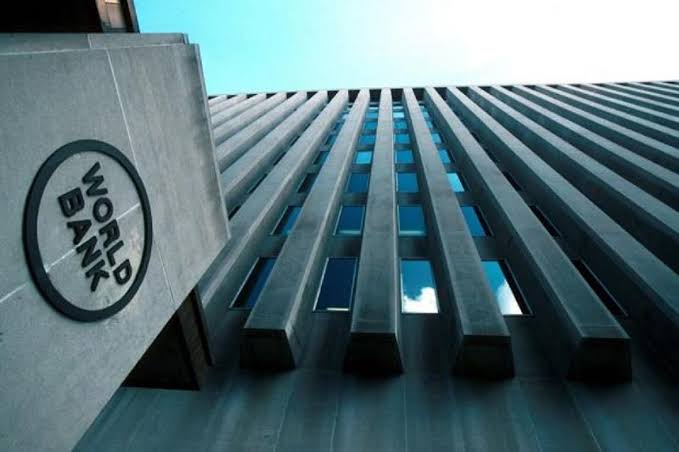
 The World Bank on Thursday approved a $100.4 million grant for Afghanistan to fight the pandemic COVID-19 in the country.
The World Bank said in a statement that the aid is dedicated to Afghanistan for the COVID-19 Emergency Response and Health Systems Preparedness Project to help Afghanistan take effective action to respond to the threat posed by COVID-19 and strengthen its public health preparedness.
“This new fast track package will cover all 34 Afghan provinces and reinforce essential health care services to slow down the spread of COVID-19 across Afghanistan and deliver optimum care in the case of a surge in demand for treatment,” the statement said.
The statement noted that the financing will support infected people, at-risk populations, medical and emergency personnel as well as service providers, medical and testing facilities, and national health agencies.
The project is financed by a grant from the International Development Association (IDA), the World Bank Group’s fund for the poorest countries, in the amount of $100.4 million, of which $19.4 million is provided from the World Bank’s COVID-19 Fast-Track Facility. It will be implemented by the Ministry of Public Health supported by UN agencies and service providers already working under the Sehatmandi project.
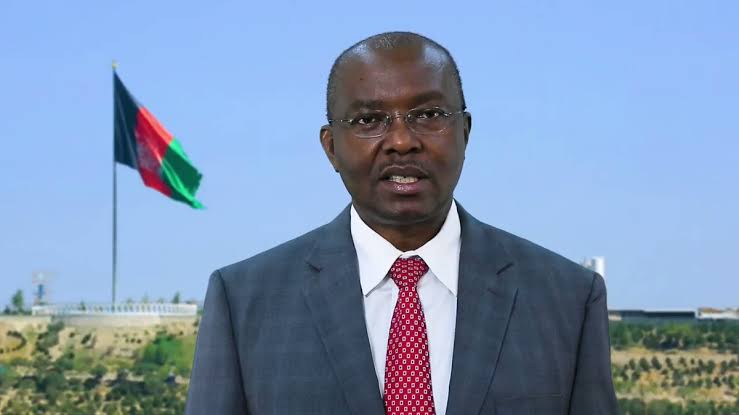 “The World Bank stands firm with the Afghan government and people to fight the spread of COVID-19 in the country,” said , World Bank Country Director for Afghanistan.
“This emergency support package will help Afghanistan’s health system mitigate the impact of an outbreak and strengthen health services. The World Bank, together with the Government of Afghanistan and other partners, will work tirelessly to implement this project and is committed to helping Afghanistan lessen the impact posed by COVID-19 in the most effective way,” Kerali added.
The project will also help address significant negative externalities expected in the event of a widespread COVID-19 outbreak, including comprehensive health awareness and behavior change campaigns.
It comes as the number of positive cases for the Coronavirus has risen to 274 with six deaths in Afghanistan.







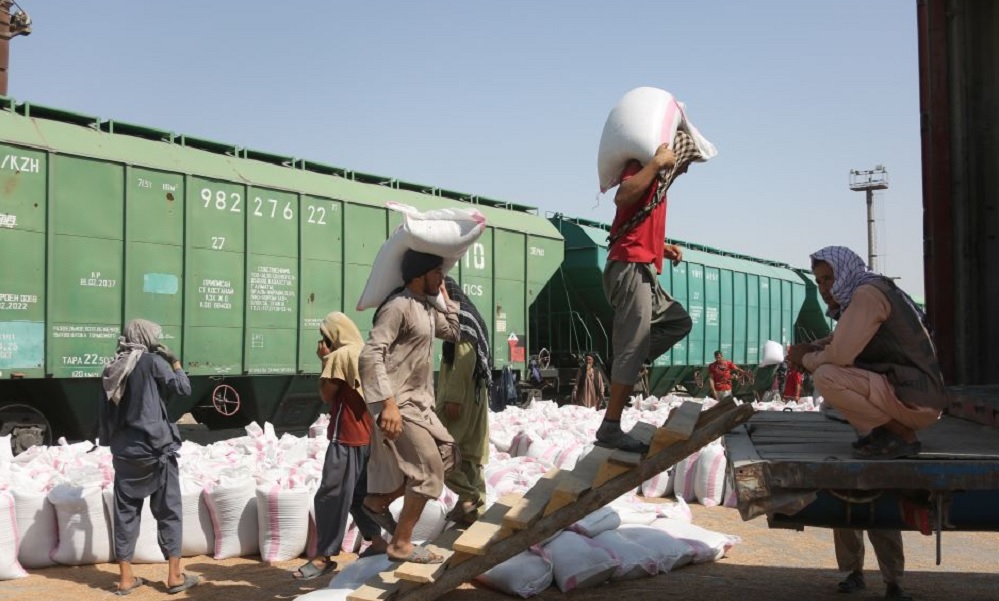
The Hairatan railway port in northern Afghanistan receives between 280 and 300 freight wagons daily from Central Asian countries, highlighting its growing role in connecting Afghanistan to regional and international markets.
The 75-kilometer Hairatan–Mazar-e-Sharif railway links Afghanistan with Uzbekistan and provides a key route for transporting goods from Central Asia, China and other international markets into the landlocked country.
Sayed Qadim Karimi, head of railway transportation at Hairatan port, told China’s Xinhua news agency that trade activity had increased this year, with an average of 280 to 300 wagons arriving at the port each day.
He said the railway transports a wide range of goods to Afghanistan, including clothing, medical equipment, machinery and electrical equipment, adding that trade with China had expanded in recent years.
Afghan traders say the railway connection has helped strengthen commercial ties with China and other regional countries while making it easier to transport imported goods.
“We transport our goods from China by freight train via Kazakhstan and Uzbekistan and receive them at Hairatan port,” businessman Ahmad Agha told Xinhua.
Agha said trade with Chinese businesses offered promising opportunities and expressed hope that further railway development would strengthen commercial ties with Kazakhstan, Russia and European countries.
He added that rising cargo volumes had created employment opportunities for local residents, with hundreds of workers handling containers at the port daily to support their families.
Another Afghan businessman, Ahmad Farid Fardan, who imports women’s clothing and colorful fabrics from China, said the railway connection had strengthened trade relations between the two countries.
Fardan expressed hope that expanding railway networks would help Afghanistan broaden its trade and economic relations with China and other countries in the region.
The railway’s role in China-Afghanistan trade dates back to 2016, when the first cargo train from China reached Hairatan as part of a pilot project. In 2019, Afghanistan sent its first export train to China, carrying several containers of talc powder.
The Hairatan railway remains an important transport link for Afghanistan’s import and export activities, offering access to regional markets and broader trade networks extending to Kazakhstan, Kyrgyzstan, Russia, China and Europe.
Business
Afghanistan, US business leaders discuss trade and investment opportunities
Hashemi welcomed the delegation and underscored the importance of strengthening cooperation between the Afghan and US private sectors.
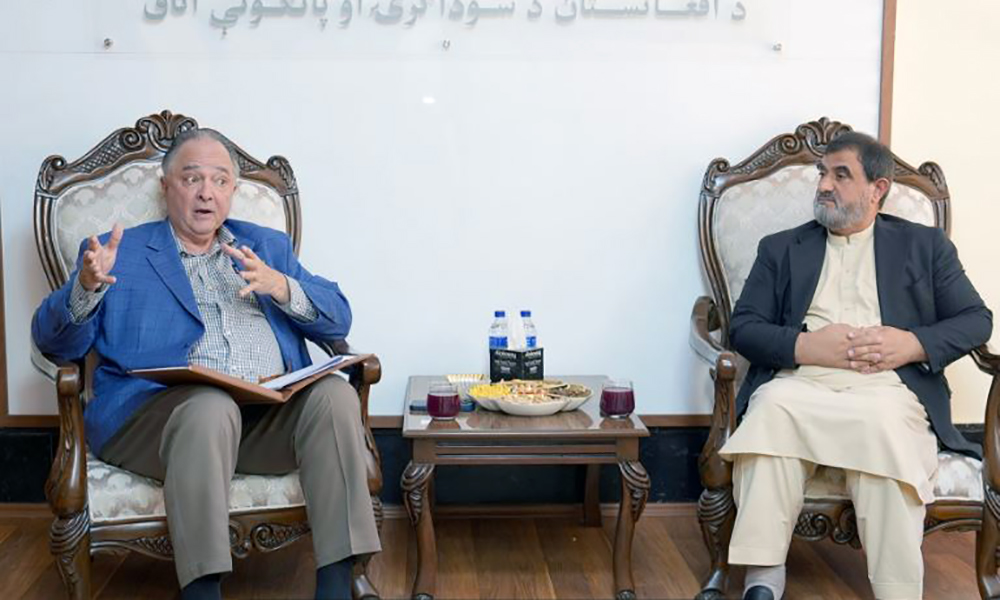
Afghanistan’s Chamber of Commerce and Investment (ACCI) has met with the Afghanistan–America Joint Chamber of Commerce to discuss expanding economic cooperation, strengthening trade ties and identifying potential investment opportunities.
According to the ACCI, the meeting was held on Sunday, October 11, at its headquarters in Kabul. Participants included ACCI Director General Sayed Karim Hashemi, Afghanistan–America Joint Chamber of Commerce President Jeffrey Greico and several members of the joint chamber.
Hashemi welcomed the delegation and underscored the importance of strengthening cooperation between the Afghan and US private sectors. He said establishing large joint-stock companies involving domestic and foreign investors could provide an effective financing mechanism for major economic projects.
Highlighting Afghanistan’s economic potential, Hashemi encouraged American businesses and investors to explore opportunities in infrastructure and industry, particularly oil refining, mineral extraction and processing, and large-scale manufacturing.
Greico praised the ACCI’s efforts to promote Afghanistan’s business environment, describing the fifth Imam Abu Hanifa National and International Exhibition as an important platform for showcasing the country’s economic potential and expanding commercial ties. The exhibition brought together traders, industrialists and representatives from neighbouring and regional countries.
He also proposed holding specialized economic discussions and panel sessions, encouraging Afghan businesses to participate in regional and international conferences, and strengthening engagement with international economic institutions.
Members of the Afghanistan–America Joint Chamber of Commerce also presented their views and proposals on expanding bilateral trade and identifying opportunities for joint investment.
Business
Afghanistan signs nearly $400 million in regional trade and investment deals
The event also featured business-to-business meetings, providing Afghan and foreign companies with opportunities to discuss potential joint investments and commercial partnerships.

Afghanistan has signed trade and investment memorandums of understanding worth nearly $400 million with regional and international companies, according to the Afghanistan Chamber of Commerce and Investment (ACCI).
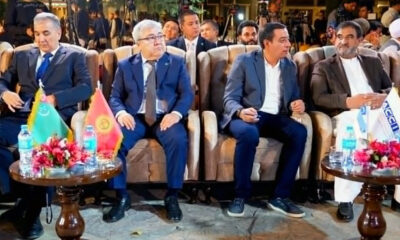
The agreements were signed on Friday evening during a business matchmaking event held on the sidelines of the fifth Imam Abu Hanifa National and International Exhibition in Kabul.
The event brought together Afghan business representatives, foreign investors and diplomatic officials, with participants from Uzbekistan, India, Kazakhstan, Turkmenistan and Kyrgyzstan attending discussions aimed at expanding economic cooperation and strengthening commercial ties with regional markets.
The ACCI said the meetings highlighted Afghanistan’s strategic geographic location, natural resources, agricultural potential, industrial capacity and domestic products as areas offering opportunities for foreign investment.
Zulgi Arin Azimi, the chamber’s deputy head for investment affairs, described the exhibition and business meetings as important platforms for building trust, strengthening economic partnerships and encouraging international investors to explore opportunities in Afghanistan.
Sherzad Ibrahimov, deputy chairman of the Uzbekistan Chamber of Commerce and Industry, stressed the importance of implementing previously signed agreements and removing technical and administrative barriers to trade.
The event also featured business-to-business meetings, providing Afghan and foreign companies with opportunities to discuss potential joint investments and commercial partnerships.
The ACCI said the newly signed agreements could help boost trade, attract foreign investment and create opportunities for businesses in Afghanistan and partner countries. However, it did not disclose the sectors covered by the agreements or provide details on their implementation timelines.
The agreements come as Afghanistan seeks to expand regional economic cooperation and attract foreign investment through international trade exhibitions and direct engagement between businesses.


Ukraine’s Zelenskiy says it is ‘painful’ when Trump chooses a different side

Tahawol: Kyrgyzstan’s rejection of Afghan refugees discussed

Saar: Central Asia’s trade alternative to Pakistan discussed

ARCS, UK envoy discuss humanitarian needs of vulnerable Afghans

FM Muttaqi says IEA values ties with India under its balanced foreign policy

Cricket Bonanza: Afghanistan set for packed international schedule

UN warns of mounting humanitarian and human rights pressures in Afghanistan

Afghanistan says 28 killed, 32 captured in Nuristan operation

CNN, MS NOW and Politico sue Trump, challenging White House ban

Silk Road highway in Wakhan corridor now reaches the China border
Tahawol: Kyrgyzstan’s rejection of Afghan refugees discussed
Saar: Central Asia’s trade alternative to Pakistan discussed

Tahawol: Warnings over worsening insecurity in Pakistan discussed

Saar: Concerns over potential return of US military bases to Afghanistan discussed

Tahawol: Kabul’s criticism of Islamabad’s policy toward Afghanistan
-
 Latest News5 days ago
Pakistan issues new directives for Afghan medical students and doctors
-
 Latest News5 days ago
Iranian lawmaker praises Afghanistan’s support, accuses Pakistan of ‘hypocrisy’
-
 Regional4 days ago
Houthis warn airlines to avoid Saudi airports after deadly Riyadh attack
-

 World3 days ago
One dead in new attack on Saudi airport, a day after Houthi strike kills 13
-
 Business5 days ago
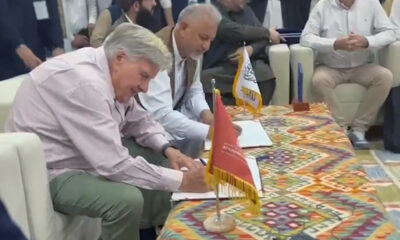
Afghan-Austrian partnership aims to boost carpet exports to European markets
-

 Sport4 days ago
Afghanistan Champions League second half to kick off on October 16
-

 World4 days ago
14 killed in two separate mass shootings across the United States
-
 Business4 days ago
Afghanistan signs nearly $400 million in regional trade and investment deals