
World
Bill and Melinda Gates to divorce, but charitable foundation to remain intact


Billionaire benefactors Bill and Melinda Gates, co-founders of one of the world’s largest private charitable foundations, filed for divorce on Monday after 27 years of marriage but pledged to continue their philanthropic work together.
The Bill & Melinda Gates Foundation has become one of the most powerful and influential forces in global public health, spending more than $50 billion over the past two decades to bring a business approach to combating poverty and disease.
The Gates have backed widely praised programs in malaria and polio eradication, child nutrition and vaccines. The foundation last year committed some $1.75 billion to COVID-19 relief.
In a joint petition for dissolution of marriage, the couple asserted their legal union was “irretrievably broken,” but said they had reached agreement on how to divide their marital assets. No details of that accord were disclosed in the filing in King County Superior Court in Seattle.
Bill Gates, 65, who co-founded Microsoft Corp (MSFT.O), and his spouse, Melinda French Gates, 56, met after she joined the software giant as a product manager, and they dated for a few years before marrying in January 1994 in Hawaii.
“After a great deal of thought and a lot of work on our relationship, we have made the decision to end our marriage,” the two said in a joint statement posted on each of their individual Twitter accounts.
“We no longer believe we can grow together as a couple in the next phase of our lives. We ask for space and privacy for our family as we begin to navigate this new life,” they said.
The divorce petition, which states that the couple have no minor children, comes after the youngest of their three offspring recently turned 18.
Launched in 2000, the nonprofit Bill & Melinda Gates Foundation ranks as the largest private philanthropic foundation in the United States and one of the world’s biggest, with net assets of $43.3 billion at the end of 2019, according to the latest full-year financials shown on its website.
From 1994 through 2018, the couple gifted more than $36 billion to the Seattle-based foundation, the website said.
Last year, investor Warren Buffett reported donating more than $2 billion of stock from his Berkshire Hathaway Inc (BRKa.N) to the Gates Foundation as part of previously announced plans to give away his entire fortune before his death.
‘NO CHANGES TO THEIR ROLES’
In their divorce petition, the couple asks the court “to dissolve our marriage” and to divide their communal property, business interests and liabilities “as set forth in our separation contract,” though that accord was not made public.
Bill Gates is ranked No. 4 on the Forbes list of the world’s wealthiest individuals, with an estimated $124 billion fortune.
In a separate statement, the Gates Foundation said the couple would remain as co-chairs and trustees of the organization.
“They will continue to work together to shape and approve foundation strategies, advocate for the foundation’s issues, and set the organization’s overall direction,” the foundation’s statement said.
The split comes two years after another leading Seattle-based billionaire and philanthropist, Amazon.com Inc (AMZN.O) founder Jeff Bezos, said that he and his then-wife, MacKenzie, were getting divorced.
At least one critic of billionaire benefactors cited the Gates’ split as a cautionary tale in the wisdom of concentrating so much sway over global humanitarian issues under the control of super-wealthy individuals.
“The Gates divorce will do more than upend a family’s life. It will ramify into the worlds of business, education, public health, civil society, philanthropy, and beyond,” Anand Giridharadas, author of the book “Winners Take All” told Reuters.
“That is because our society has made the colossal error of allowing wealth to purchase the chance to make quasi-governmental decisions as a private citizen,” he said.
Gates dropped out of Harvard University to start Microsoft with school chum Paul Allen in 1975. Gates owned 49% of Microsoft at its initial public offering in 1986, which made him an instant multimillionaire. With Microsoft’s explosive growth, he soon became one of the world’s wealthiest individuals.
After an executive tenure in which he helped transform the company into one of the world’s leading technology firms, Gates stepped down as CEO of Microsoft in 2000 to focus on philanthropy. He remained chairman until 2014 and left the company’s board in March 2020.
Known in the technology industry as an acerbic and ruthless competitor, Gates drew the ire of rivals and eventually the U.S. government for Microsoft’s business practices.
The software giant was convicted of antitrust violations in the late 1990s. But the verdict was overturned on appeal, and the company then settled the case out of court.
Gates’ public persona softened into an avuncular elder statesman as he turned his attention to philanthropy, and he has largely steered clear of the many controversies currently roiling the technology business.
Melinda French Gates, who recently added her maiden name on most of her websites and social media, was raised in Dallas and studied computer science and economics at Duke University before joining Microsoft.
In 2015 she founded Pivotal Ventures, an investment company focused on women and families, and in 2019 published a book, “The Moment of Lift”, centered on female empowerment.





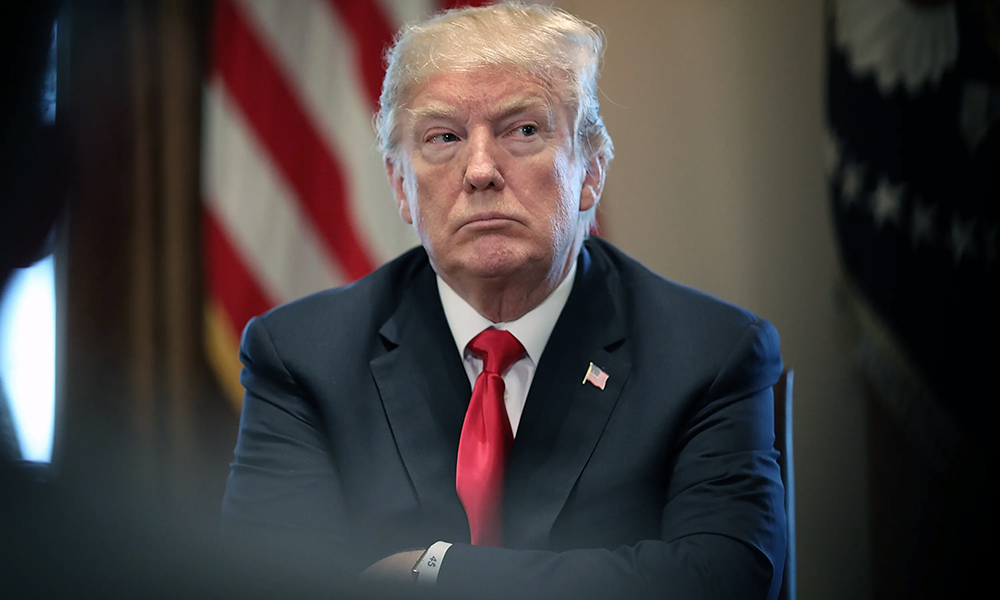
U.S. President Donald Trump says he does not regret launching the war against Iran, despite its potential impact on the November midterm elections.
In an interview with Fox News host Laura Ingraham, Trump said that if given the choice again, he would take the same course of action, adding that he does not believe in the word “regret.”
Trump also dismissed suggestions that some of his supporters had become upset or demoralized over the war, saying they were proud that he was preventing Iran from obtaining a nuclear weapon.
He also reiterated his claim that the war would end immediately after the midterm elections, saying, “It ends right after the election.”
The conflict and the resulting rise in oil and gas prices have become a major political issue for Republicans ahead of the elections.
The United States and Israel launched attacks on Iran on February 28, while Iran responded with strikes on Israel and Gulf states hosting U.S. military bases. The fighting has reportedly killed thousands and displaced millions.
Trump has cited the weakening of Iran’s nuclear capabilities as one of the main objectives of the war. Iran, however, says its uranium-enrichment program is peaceful and maintains that it does not possess nuclear weapons.
World
Trump touts $5,000 payout if Republicans win as Vance waits in wings
It was not immediately clear how the $5,000 payments would work or whether they would be legal. The proposal would likely cost more than $1 trillion, with approximately 270 million U.S. adults, and could require the approval of Congress.
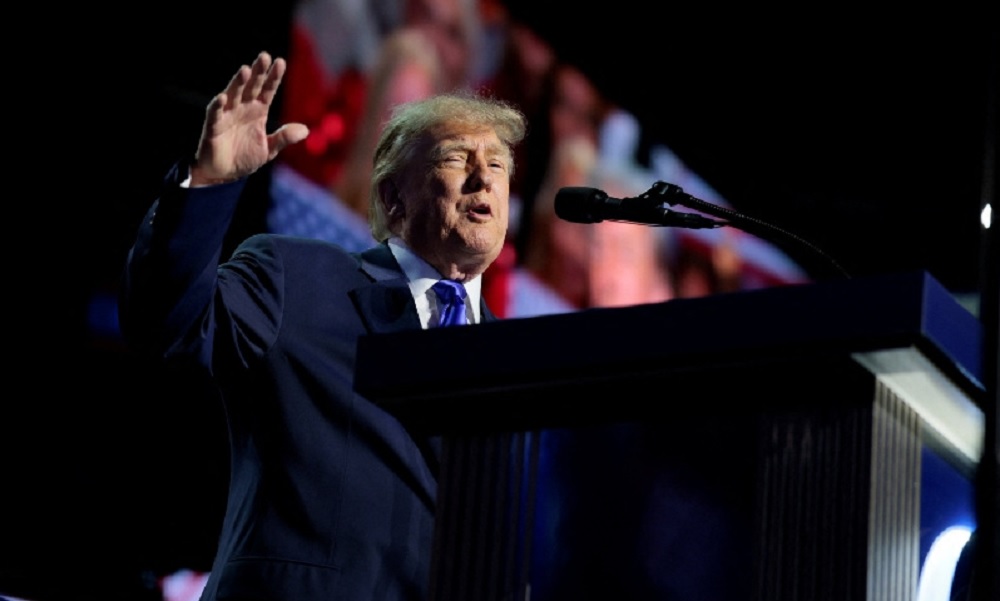
President Donald Trump capped the first day of his Republican Party’s first-ever midterm convention by proposing to pay every U.S. adult a $5,000 “Trump dividend” if his party wins November’s congressional elections.
Trump delivered the extraordinary overture during a primetime speech that lasted nearly two hours and firmly placed him at the center of the midterm campaign at a time when his sagging approval ratings could weigh on Republicans’ chances, Reuters reported.
Vice President JD Vance will give the keynote address on Thursday night, though Trump is scheduled to make closing remarks to bring the made-for-television two-day event in Dallas to an end.
With Trump constitutionally barred from seeking a third term, Vance’s speech could serve as an early audition for the 2028 presidential election and offer clues about how he would lead a party reshaped by Trump.
It was not immediately clear how the $5,000 payments would work or whether they would be legal. The proposal would likely cost more than $1 trillion, with approximately 270 million U.S. adults, and could require the approval of Congress.
The convention’s focus on Trump – some Republicans have dubbed it “Trumpapalooza” – amounts to a risky bet that he can mobilize the voters who carried him to the presidency two years ago, despite opinion polls showing his popularity is at an all-time low.
But it remains to be seen whether his campaign-style speech will appeal to the critical swing voters who have drifted away from Trump’s party amid growing dissatisfaction with the cost of living and the war on Iran.
‘PRETEND THAT I’M ON THE BALLOT’
“I’m asking you to pretend that I’m on the ballot,” Trump said, a line that may have pleased Democratic campaign strategists just as much as MAGA voters.
Republican efforts got a boost from an unlikely source on Wednesday, when Democratic U.S. Senator John Fetterman appeared in a pretaped video segment introducing his “great friend,” fellow Pennsylvania Senator Dave McCormick, a Republican.
Fetterman said he would always “reject the extremes in socialism,” a comment that is likely to bolster Republican attacks on Democrats as too left-wing. Fetterman, who has increasingly broken with his fellow Democrats, has nevertheless rejected speculation that he might leave the party.
Some vulnerable Republicans in tough races, perhaps mindful of tying themselves too closely to the unpopular Trump, elected to skip the affair, including Senator Dan Sullivan of Alaska and Senator Susan Collins of Maine.
DEMOCRATS PORTRAYED AS ‘SOCIALISTS’ AND ‘COMMUNISTS’
While Republican officials had described the convention as an opportunity to tout Trump’s policies, most speakers focused on attacking Democrats as extreme on topics such as transgender women in sports and border security – political red meat for core Trump supporters.
Alabama state Representative Ernie Yarbrough, a convention attendee, said Trump needs to give voters a clearer sense of how long the war in Iran could last.
“People want to feel like we’re not getting stuck in an endless cycle,” he said.
Trump defended his decision to attack Iran, saying he acted to prevent Tehran from developing a nuclear weapon. He also promised that oil prices would drop “as soon as we win the war with Iran,” which he vowed would happen soon.
But the conflict shows little sign of ending more than six months after the U.S. and Israel launched strikes on Iran, and analysts have said Iran’s nuclear program has not been eliminated. Iran denies seeking a nuclear weapon.
Before Trump took the stage, a parade of speakers called Democrats “socialists” and “communists,” echoing one of Trump’s favorite attack lines. Democrats are “dangerous, radical and weird,” said Senator Tim Scott of South Carolina, the chairman of the party’s Senate campaign arm.
The stakes are high for both parties. With the elections less than two months away, Republicans face the prospect of losing control of at least one chamber of Congress, with public polling showing Democrats more motivated to vote and Trump’s approval ratings deeply underwater.
World
US Treasury ratchets up pressure on Iran with sweeping new aviation sanctions
Treasury Secretary Scott Bessent last week warned that airlines were possible sanctions targets along with digital assets and the maritime industry.
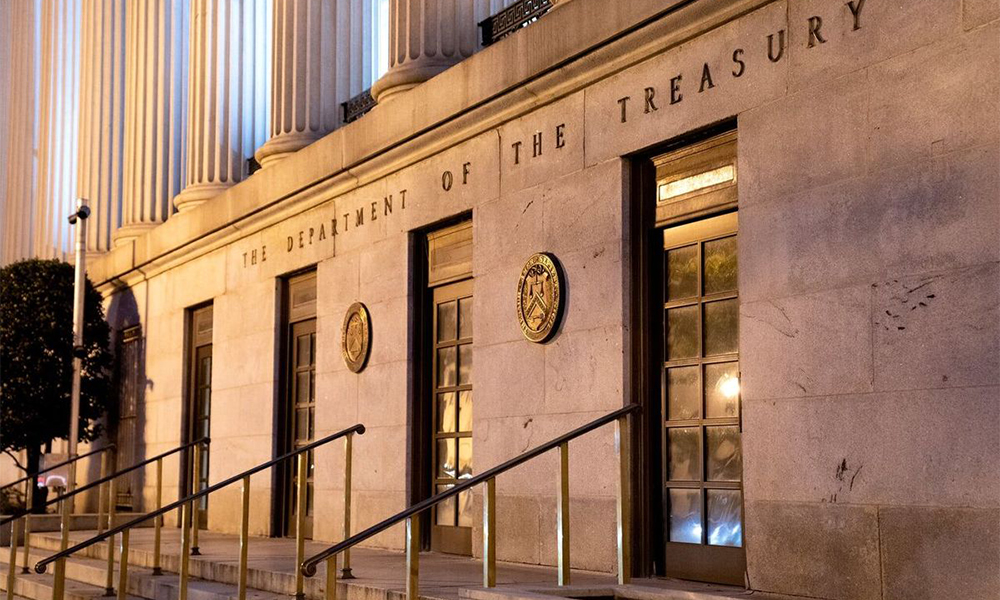
The United States on Tuesday issued 36 Iran-related sanctions targeting the country’s aviation sector and other companies as part of a broad push to escalate economic pressure on Tehran as the war in the Middle East has moved into a seventh month, Reuters reported.
The U.S. Treasury Department said the action was aimed at grounding Iran’s Mahan Air, which was already sanctioned by the U.S. and the European Union, and expanding sanctions to all other Iranian airlines. The sanctions also took aim at covert front companies, cargo handlers, foreign intermediaries and deceptive trans-shipment routes that Washington says Iran relies on to obtain U.S.-origin aircraft and sensitive technology.
The Treasury instructed financial institutions to report any procurement networks supporting Iran’s aviation industry, while designating firms in Turkey, the United Arab Emirates, Malaysia and Kazakhstan that it said had helped Iran’s airlines operate and Tehran acquire U.S.-origin aircraft and sensitive technology.
Treasury’s Office of Foreign Assets Control also suspended three Iran-related aviation authorizations that allowed overflights and permitted non-U.S. airlines to fly U.S.-origin or U.S.-controlled commercial aircraft into Iran.
Miad Maleki, a former senior Treasury official and fellow at the Foundation for Defense of Democracies, said the suspension would hit air traffic from Dubai, Doha and Istanbul, shutting Tehran’s main gateways to regional trade and finance. OFAC’s action also closes previous carve-outs that allowed transport of safety parts, fuel and emergency repairs, he said.
Tuesday’s actions marked a sharp escalation of the Trump administration’s renewed push to squeeze Iran’s economy and pressure Tehran to loosen its chokehold on the Strait of Hormuz. A U.S. naval blockade and tougher sanctions are curbing Iran’s oil exports, restricting access to foreign currency and exposing growing strains in the economy.
Treasury said any foreign firm or individual aiding Iranian airlines through aircraft transfers, cargo services or general sales agent support would face serious consequences.
Treasury Secretary Scott Bessent last week warned that airlines were possible sanctions targets along with digital assets and the maritime industry.
”Under Operation Economic Outcast, we promised severe consequences for those providing financial lifelines to the Iranian regime,” Bessent said in a statement on Tuesday. “Let this be a warning to anyone doing business with Iran’s remaining airlines, all of which we sanctioned today: You are at risk of being cut off from the global financial system.”
On Tuesday, Treasury designated 27 Iranian airlines, as well as several firms based in Turkey and the United Arab Emirates for helping Mahan Air secure at least three Boeing B-777 aircraft this summer that had been retired elsewhere, read the report.
It hit UAE-based Egyptian citizen Ibrahim Ali Mohamed Mohamed Mahran, the chief executive of ECT Aviation Support, as well as the British unit of the firm.
OFAC also imposed sanctions on two firms based in Turkey and Malaysia that it said had serviced Mahan Air’s international flights and coordinated cargo shipments.
The U.S. Treasury has repeatedly targeted global networks supporting Mahan Air. In July, Treasury designated six entities and individuals in China, India, Russia and Iran, including several firms that act as sales agents for the airline. Washington first sanctioned Mahan in 2011 over support it provided to Iran’s Islamic Revolutionary Guard Corps.
In 2020, Washington imposed sanctions on a China-based company it accused of acting on behalf of Mahan Air.
Brett Erickson, managing principal of Obsidian Risk Advisors, said the latest moves were significant.
“The United States is using sanctions to effectively blockade Iran’s aviation sector from the rest of the world,” he said. “That represents a major expansion of the economic war, with foreseeable consequences for civilian travel, commerce, supply chains and Iran’s ability to sustain their strained economy.”


Tahawol: Norwegian delegation’s call for engagement with Afghanistan discussed

Sorkh Poshan Khafi and Ariana Khost claim victories in ACL season six

Saar: Pakistan’s dual policy towards Afghanistan reviewed

Chinese ambassador, Muttaqi discuss expanding bilateral relations

Afghan official highlights Badakhshan operation at China security forum

Four mediators struggle to secure lasting Pakistan-Afghanistan ceasefire

Juma Khan Fateh surrenders to IEA forces in Badakhshan

Afghanistan’s trade diversification challenges Pakistan

Syria and Saudi Arabia condemn Kabul bombing, express solidarity with Afghanistan

Afghanistan crowned champions of five-match ODI series against Ireland
Tahawol: Norwegian delegation’s call for engagement with Afghanistan discussed
Saar: Pakistan’s dual policy towards Afghanistan reviewed

Exclusive interview with ACB CEO Naseeb Khan

Saar: UN reaffirming support for Afghanistan discussed

Saar: Pakistan’s decision to expel Afghan medical students discussed
-

 Latest News4 days ago
Amnesty International condemns Pakistan order requiring Afghan medical students to return
-
 Latest News4 days ago
Afghan Embassy in Islamabad calls for halt to expulsion of Afghan students
-
 Latest News4 days ago
Kabul police spokesman condemns Pakistan order expelling Afghan medical students
-

 Latest News4 days ago
IEA: US military equipment left in Afghanistan belongs to Afghan government
-
 Latest News4 days ago
Qatar reaffirms commitment to supporting dialogue and engagement on Afghanistan
-

 Science & Technology5 days ago
AI could pose ‘existential’ risk to humanity, UN rights chief warns
-
 Latest News3 days ago
Muttaqi and Bangladeshi delegation discuss expansion of bilateral ties
-

 Business3 days ago
UAE firm eyes investment in Salang’s second tunnel and pharmaceutical factories